Chapter 20
New Testament page 159, photographed, quoted, and placed on the record
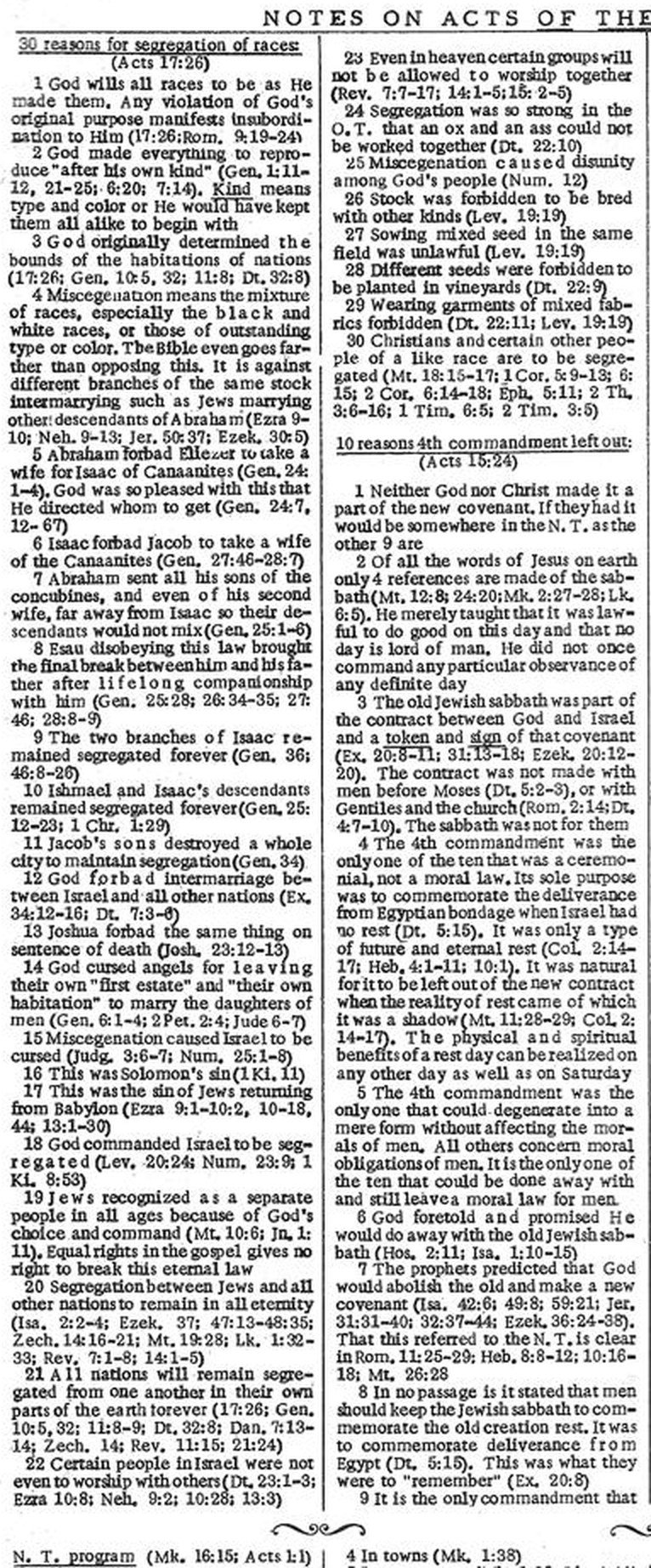
I have a photograph in front of me. Two narrow columns of small serif type, packed tight, almost no white space. No pictures. No color. It looks like every other notes page in the Dake Annotated Reference Bible, because that is exactly what it is.1
The running head across the top says NOTES ON ACTS OF THE APOSTLES CONTINUED. The page number is in the corner. 159.2
This is the New Testament section of the book. Page 159 is not Scripture. It is a page of Dake's own notes, carried over from the pages where the text of Acts is printed. At the top of the first column sits a short underlined title, and below it, on a centered line, a verse reference in parentheses. Then a numbered list begins. It runs down the column, crosses into the next, and stops at thirty.
The title reads:
30 reasons for segregation of races:
(Acts 17:26) Dake Annotated Reference Bible, pre-1988 printing, N.T. p. 159, note on Acts 17:26
That is the whole heading. A number, a subject, and the verse it explains.
You need to understand what kind of book this sits in. A reference Bible is not a commentary on the shelf next to your Bible. It is your Bible. The notes are bound right in with the text, keyed to the verses, and carried to church in the same hand. Dake spent decades on his. The result is enormous. Notes crowd nearly every page in narrow columns, with cross-references running through them like wiring.
That is part of what makes a page like this one easy to miss. It does not stand out. It is one note among thousands.
This chapter does one thing. It shows you that page, and then it shows you what was around it.
I will not argue with the note here. The Bible's answer fills all of Chapter 21, the longest and most Scripture-heavy chapter in this book. What happened to this page after Dake died fills Chapter 22. This chapter documents. It shows the photographs, quotes the notes, says where they sat, and stops.
I have a reason for that restraint. This page gets quoted often, and it gets quoted badly. I have seen it softened into a vague remark about a man's "views on race." I have also seen it sharpened into things it does not actually say. Both failures are real, and the second one hands the first an excuse. So everything here is photographed. The full text, every word, is transcribed in Appendix B.3 You do not need to take my word for any of it. You can read the page yourself.
A person writes many things in a lifetime. Some of them he would not defend at sixty. If this note had shown up in a pamphlet, or a letter, or a sermon preached once and never printed, it would still be worth knowing about. But it would not be worth a chapter.
This is a Bible note. That changes everything.
Think about how a study Bible works on the eye. Scripture sits at the top or center of the page. The notes run beneath it or beside it, in the same book, the same type, under the same cover, with the same name on the spine. Nothing on the page tells you where the inspired text ends and one man's opinion begins. You know the difference in theory. In practice, the layout does its own quiet work.
I grew up around Bibles like this. So did most of the people I am writing for. When you are seventeen and reading a passage you do not understand, your eye drops to the note. The note is confident. It has verse references. It sounds like it knows. And so the note becomes, for many readers, what the verse means.
The preface of this Bible tells you who it was written for.
Sunday school teachers and scholars will find much herein to help them with the weekly lesson. Preface, Dake's Annotated Reference Bible, p. i4
So this was not printed as one man's commentary. It was printed as Bible help, in a Bible, for churches and Sunday schools and teenagers doing their homework. It has verse references thirty times over. Its numbered format looks just like the format used for the notes about prayer and preaching on the same page.
Think about how that plays out in a real room. A class is working through Acts. Somebody asks the question that was in every American church in those years, the question about who sits where and who marries whom. The teacher does what teachers do. He looks at the notes on the page.
He is not a scholar. He has no Greek. He has this book because a good man told him it was the most helpful study Bible in print, and the notes have always answered his questions before. And right here, under the verse the class is reading, is an answer. Numbered. Sourced. Thirty reasons deep.
I cannot tell you how many teachers had that experience. Nobody can, and I am not going to invent a number. But the book sold widely, and it sold into exactly the churches where that question was live.
And the note teaches something. Look at the heading again. It does not say segregation happened. It does not say some Christians once believed in it. It gives reasons for it, from the Bible, in a Bible.
Here is the sharper point, and I want to make it carefully.
Dake had a rule for reading Scripture. He did not hide it. He printed it in the front of this very volume, in capital letters, as the governing principle of the whole work.
The general principle adhered to throughout is that of literalizing instead of spiritualizing. Statements of fact and historical accounts are accepted as such. THE RULE OBSERVED IS: Take the Bible literally wherein it is at all possible; if symbolic, figurative or typical language is used, then look for the literal truth it intends to convey. Preface, Dake's Annotated Reference Bible, p. iii5
On the same page he explains what he aimed to do with that rule.
In the preparation of this work, therefore, the aim has been to prove the teachings of the side-columns with plain Bible references; and now, the reader is invited to see for himself what these related passages actually say on any given subject of the notes. Preface, Dake's Annotated Reference Bible, p. iii6
I take up that rule, and what it does to his whole system, in Chapter 4. Here I only want you to see the shape of it, because the note on page 159 follows that shape exactly.
Look at the form. Thirty numbered claims, each with Scripture references. No sermon here. No story. No appeal to Southern custom or the way things were always done. This note does not argue the way a person argues when he is defending an arrangement he grew up in. It argues the way a person argues when he is proving a doctrine, by the method the front of the book promised.
That is what makes it serious. This is not Dake having a bad day. It is not his culture leaking onto the page in one careless moment. It is Dake doing what he did on every other page of this Bible, by the method he taught his readers to trust, and arriving here.
One more thing, and it is closer to home. Some of you reading this own a copy. It may have been your grandfather's. If your copy was printed before 1988, this page is in it right now, about two-thirds of the way through the New Testament. If your copy came later, the page has been changed, and nothing in the book tells you so. That story belongs to Chapter 22. For now, I only want you to know which copy you are holding.
Here is the note as it was photographed.
Look at what you are seeing. The note sits at the top of the first column, right where your eye lands. It is set in the same type as everything around it. There is no warning, no bracket, no editorial comment. It is simply the next thing on the page.
The small things are worth naming. There is no rule above the note other than the thin line that separates every note from the one before. Its title is underlined, the way other titles on the page are. The item numbers run without periods. The Scripture references sit in parentheses at the end of each item, in the same abbreviations used throughout the book.
Everything about the layout says the same thing: this is ordinary. This is one more note. Read it the way you read the others.
Now the edition. Here the record has improved since I first worked on this chapter.
The two best photographs of page 159 come from printings the author of the images identifies as 1965 and 1976. Neither page carries a date on it. Bibles do not print the year in the running head.8 So for a long time I could date this material only by its content. Beginning in 1988, the year after Dake died, his publishers began changing the note. Any copy that still carries it in its original wording was printed before that change.9
Since then a third volume has reached me, and this one has a copyright page.
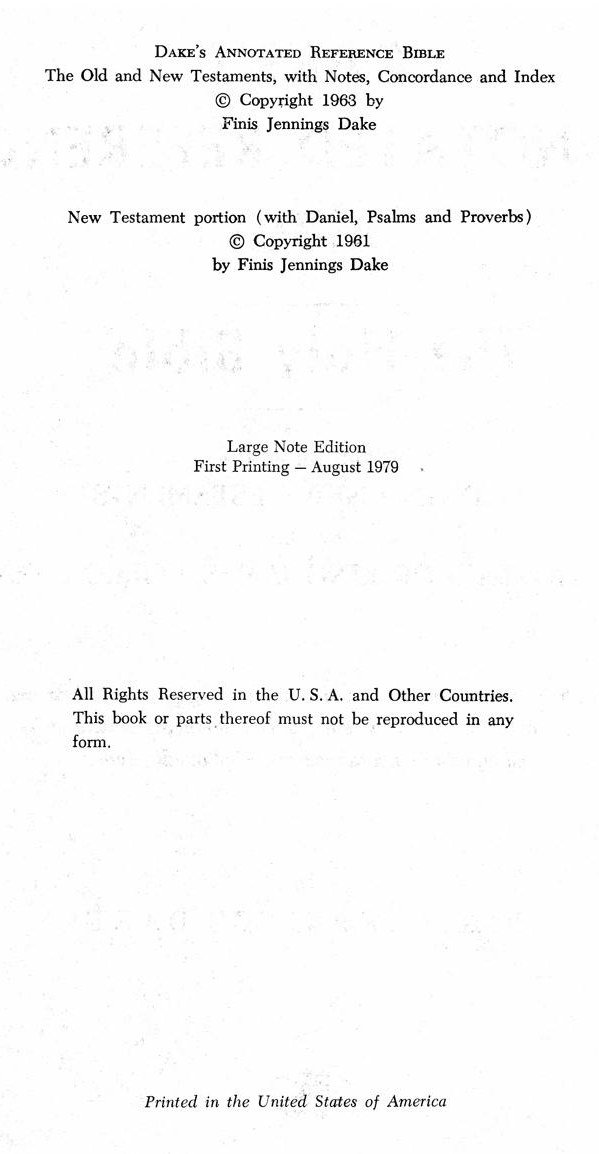
That page settles several things. It gives the copyright years for the work. It names the publisher's edition. And it gives a month and year for one press run, which is more than any photograph of page 159 has given me.
I do not have a separate photograph of page 159 from this volume. But I do not need one. The book's own machinery tells me what is on that page. Its index lists the note. Its Acts 17 page points to the note. I will show you both shortly. A book that indexes a page and cross-references it from the text is a book that has the page.
How These Pages Were Read
This note is famous, and famous pages get quoted from memory. I did not do that. Every reading here was taken from a photograph of the printed page. One limit should be named openly. Partway through this work my image viewer stopped displaying pictures, and I could not go on reading by eye. The readings taken before that failure are marked in the notes below as read by eye. The rest were done by careful machine reading of the same images, word by word, with a confidence score attached to every word. I say so each time. That is a weaker method, and it is disclosed rather than hidden.11
The heading has two lines, and both do work.
The first names the subject and counts the items: thirty reasons, for the segregation of races. The second, in parentheses, is the anchor. In this Bible, that parenthesis tells you which verse the note belongs to. Every note on the page has one.12
The anchor is Acts 17:26. That is the verse this note was written to explain.
Here is that verse.
"And He has made from one blood every nation of men to dwell on all the face of the earth, and has determined their preappointed times and the boundaries of their dwellings." (Acts 17:26, NKJV)13
Let me be careful about how the book is laid out, because precision is the whole point of this chapter. Page 159 is a notes page. The printed text of Acts 17 sits on an earlier page, with short notes beside it. When a note grew too long for the margin, it was carried here. So the verse itself is not on page 159. Its reference is, in the parenthesis under the heading.14
How does a reader get from the verse to the note? Through a small letter in the margin. Beside Acts 17:26, on New Testament page 144, there is a lettered note. It says this and nothing more.
See 30 reasons for segregation of races, p. 159 Note c at Acts 17:26, N.T. p. 144, pre-1988 printing15
That is the mechanism. Read the verse. See the letter. Follow it to the page. Find the thirty reasons.
A note in a reference Bible is not free-floating commentary. It is attached to a verse, and the attachment is a claim. The parenthesis says: this is what that verse teaches. The note is not just printed near Acts 17:26. It is offered as the verse's meaning.
So here is the full picture. A verse about one blood. A pointer beside it. And thirty reasons for separating the races printed underneath.
Now the note itself. I am quoting it at length, in the order the note prints it, grouped so you can see the argument move. Nothing has been reordered. Where I give a summary instead of a full quotation, I say so, and Appendix B has the complete text.
A word about language. This note uses vocabulary from its era, including a term for the mixing of races. I reproduce that language inside quotation marks, because the rule of this book is that you see the page. I do not use those words in my own voice anywhere in this book.
The note opens at creation.
1 God wills all races to be as He made them. Any violation of God's original purpose ma[ni]fests insubordination to Him (17:26; Rom. 9:19-24)
2 God made everything to reproduce "after his own kind" (Gen. 1:11-12, 21-25; 6:20; 7:14). Kind means type and color or He would have kept them all alike to begin with
3 God originally determined the bounds of the habitations of nations (17:26; Gen. 10:5, 32; 11:8; Dt. 32:8)
4 Miscegenation means the mixture of races, especially the black and white races, or those of outstanding type or color. The Bible even goes farther than opposing this. It is against different branches of the same stock intermarrying such as Jews marrying other descendants of Abraham (Ezra 9-10; Neh. 9-13; Jer. 50:37; Ezek. 30:5) Dake Annotated Reference Bible, pre-1988 printing, N.T. p. 159, note on Acts 17:26, reasons 1–4
In plain words: the races as we see them are how God made them and how God wants them. To mix them is to disobey Him. The word "kind" in Genesis 1, used there of plants and animals, is being stretched to cover skin color. And the rule goes further than it first sounds. Reason 4 says the Bible opposes not only the mixing of different races but the intermarriage of branches within the same family.16
Reason 2 is the hinge of the entire note. Everything turns on one word.17
Same Words, Different Meanings: "Kind"
The word on his page. Reason 2 says God made everything to reproduce "after his own kind," and then defines the term: "Kind means type and color or He would have kept them all alike to begin with."
What he means by it. Human races are separate kinds, the way different animals are separate kinds. Skin color marks the boundary. He is consistent about it. In a list elsewhere in the same Bible, he sets out the created kinds one by one, and item 10 reads: "Man after his kind (Gen. 1:26-28; 5:1-3; 9:6; Jas. 3:9)."18
What the word means in Genesis. The Hebrew word is min ("kind, sort, category"). Genesis 1 uses it ten times, and every time it sorts plants and animals into their groups. It is never used of people. When Genesis reaches humanity in 1:26–27, the word drops out. Man is not made after kinds. Man is made in the image of God, male and female, one.19
Same word. One page uses it to divide the human race. The other page never applies it to the human race at all. The full study of that grammar belongs to Chapter 21.
From creation the note moves to the patriarchs. Reasons 5 through 13 walk through Genesis, Exodus, and Joshua, reading each story as a rule about marriage.
5 Abraham forbad Eliezer to take a wife for Isaac of Canaanites (Gen. 24:1-4). God was so pleased with this that He directed whom to get (Gen. 24:7, 12-67)
6 Isaac forbad Jacob to take a wife of the Canaanites (Gen. 27:46-28:7)
7 Abraham sent all his sons of the concubines, and even of his second wife, far away from Isaac so their descendants would not mix (Gen. 25:1-6)
8 Esau disobeying this law brought the final break between him and his father after lifelong companionship with him (Gen. 25:28; 26:34-35; 27:46; 28:8-9)
9 The two branches of Isaac remained segregated forever (Gen. 36; 46:8-26)
10 Ishmael and Isaac's descendants remained segregated forever (Gen. 25:12-23; 1 Chr. 1:29)
11 Jacob's sons destroyed a whole city to maintain segregation (Gen. 34)
12 God forbad intermarriage between Israel and all other nations (Ex. 34:12-16; Dt. 7:3-6)
13 Joshua forbad the same thing on sentence of death (Josh. 23:12-13) Dake Annotated Reference Bible, pre-1988 printing, N.T. p. 159, note on Acts 17:26, reasons 5–13
In plain words: the patriarchs kept their children from marrying outside the family line, and that practice is read here as a standing law of separation.
Watch what the note does with these passages. Every one of them is a story. Abraham sends a servant to find a wife. Esau marries and grieves his parents. The note reads each narrative as a binding rule. That move is worth paying attention to, and it is the same move Chapter 4 traces through the rest of his system.
Watch also what counts as evidence. Reasons 9 and 10 do not report a command. They report an outcome. Two family lines stayed apart, and the fact that they stayed apart is taken as proof that they were meant to.
And reason 11. The men of Shechem are killed by Jacob's sons after their sister is violated. Genesis 34 ends with the father condemning the act. The note reads that massacre as a defense of segregation.20
Reasons 14 through 18 bring in the language of curse and command.
14 God cursed angels for leaving their own "first estate" and "their own habitation" to marry the daughters of men (Gen. 6:1-4; 2 Pet. 2:4; Jude 6-7)
15 Miscegenation caused Israel to be cursed (Judg. 3:6-7; Num. 25:1-8)
16 This was Solomon's sin (1 Ki. 11)
17 This was the sin of Jews returning from Babylon (Ezra 9:1-10:2, 10-18, 44; 13:1-30)
18 God commanded Israel to be segregated (Lev. 20:24; Num. 23:9; 1 Ki. 8:53) Dake Annotated Reference Bible, pre-1988 printing, N.T. p. 159, note on Acts 17:26, reasons 14–18
In plain words: mixing brings a curse. Separation is a divine command.
The word "curse" carries heavy weight in this group. Reasons 14 and 15 both use it. The argument has moved well past what God prefers, or permits, or once arranged for one nation. Mixing brings judgment.
Reason 18 finishes the turn. It does not say Israel happened to be separate, or that separation suited their situation. It says God commanded it.
Reason 14 needs a pause. It reaches for the angels of Genesis 6, a passage Dake reads as spirit beings taking human wives, and it offers their judgment as a warning about human marriage across racial lines.21
Then the note does something the earlier reasons do not prepare you for. It moves from history into forever.
Dake's Words: The Separation That Never Ends
19 Jews recognized as a separate people in all ages because of God's choice and command (Mt. 10:6; Jn. 1:11). Equal rights in the gospel gives no right to break this eternal law
20 Segregation between Jews and all other nations to remain in all eternity (Isa. 2:2-4; Ezek. 37; 47:13-48:35; Zech. 14:16-21; Mt. 19:28; Lk. 1:32-33; Rev. 7:1-8; 14:1-5)
21 All nations will remain segregated from one another in their own parts of the earth forever (17:26; Gen. 10:5, 32; 11:8-9; Dt. 32:8; Dan. 7:13-14; Zech. 14; Rev. 11:15; 21:24)
22 Certain people in Israel were not even to worship with others (Dt. 23:1-3; Ezra 10:8; Neh. 9:2; 10:28; 13:3)
23 Even in heaven certain groups will not be allowed to worship together (Rev. 7:7-17; 14:1-5; 15:2-5) Dake Annotated Reference Bible, pre-1988 printing, N.T. p. 159, note on Acts 17:26, reasons 19–23
Read reason 19 again, slowly. It sees the objection coming and answers it before anyone can raise it. Someone will say the gospel makes all believers equal. The note agrees. And then it says the equality changes nothing: "Equal rights in the gospel gives no right to break this eternal law."22
That sentence tells you this note is not careless. It knows what stands against it. It has decided that separation outranks it.
Reasons 20, 21, and 23 push the teaching past death. Separation is not a temporary arrangement for a fallen world. It is not a rule for one nation in one covenant. It holds "in all eternity." It holds "forever." It holds, says reason 23, in heaven, where "certain groups will not be allowed to worship together."
I have read a fair amount of segregation-era religious writing while working on this book. Most of it argued from custom, or social order, or a misread curse in Genesis 9. This note goes further than most. It writes the separation into the new creation.
The last group turns to farming and cloth, and then to the church.
24 Segregation was so strong in the O. T. that an ox and an ass could not be worked together (Dt. 22:10)
25 Miscegenation caused disunity among God's people (Num. 12)
26 Stock was forbidden to be bred with other kinds (Lev. 19:19)
27 Sowing mixed seed in the same field was unlawful (Lev. 19:19)
28 Different seeds were forbidden to be planted in vineyards (Dt. 22:9)
29 Wearing garments of mixed fabrics forbidden (Dt. 22:11; Lev. 19:19)
30 Christians and certain other people of a like race are to be segregated (Mt. 18:15-17; 1 Cor. 5:9-13; 6:15; 2 Cor. 6:14-18; Eph. 5:11; 2 Th. 3:6-16; 1 Tim. 6:5; 2 Tim. 3:5) Dake Annotated Reference Bible, pre-1988 printing, N.T. p. 159, note on Acts 17:26, reasons 24–30
In plain words: the laws of Israel about breeding animals, planting fields, and weaving cloth are taken as further proof that God keeps apart what He wants kept apart. Reason 24 puts it most simply. It takes the rule against plowing with an ox and a donkey yoked together and reads it as evidence about people.
Reason 25 claims something about Numbers 12 that the chapter itself does not say. Miriam and Aaron criticize Moses over his Cushite wife. There is disunity in the story, and the note is right about that much. But the people causing it are the critics, not Moses.23
Reason 30 carries the list into the church age. It gathers the New Testament passages on church discipline and on being unequally yoked, and points them at race. Every one of those passages is about sin and unbelief. Every one of them concerns how a church handles a person's conduct or a person's faith. Not one of them mentions ancestry.24
Now step back and look at the whole shape of the thing.
The list moves in a deliberate order. It opens at creation, with God's design and the word "kind." It walks through the patriarchs and their marriages. It gathers the laws and the curses. Then it turns toward the future and makes the separation permanent, forever, even in heaven. Then it drops back to farming and cloth. Then it ends in the church.
That is the arc of a doctrine, not the shape of a grievance. Genesis to Revelation. Creation to eternity, with the practical application last.
Count the references. The thirty reasons carry more than seventy verse and chapter citations, drawn from around thirty books of the Bible.25 Whatever else is true of this note, nobody dashed it off.
That is the note. Thirty numbered reasons. Roughly three hundred words. Printed under a verse about one blood.
When I first drafted this chapter, I could not go further than page 159. I had photographs of that one page and the text of two of Dake's other books, and I said so. I searched those books for the vocabulary this note uses. The word for race mixing does not appear in either one.26 That finding stands. I repeat it here so nobody thinks I buried it. His course book does not return to this subject.
But I was looking at the wrong shelf. The question was never whether the teaching shows up in his other books. The question is whether it shows up elsewhere in this book. Roughly fifty more pages of the same Bible have since come to me, from Genesis to the Cyclopedic Index. The answer is now on the record.
It shows up constantly.
Start where a reader would start: the back of the book. This Bible has an index. The index has a headword.
Segregation, S. in Eastern cities, e 16-[?]
Fear of integration, j 20-4
Abraham's command about, o 21-4
Charge to keep s., g 26-4; r 33-1
S. in Egypt, d 47-1
S. defied by man, 60, col. 2, pt. 7
2 reasons God segregated Israel, 108
Laws of s.: 114; h 140-4; f 221-1
31 facts on s. by Moses, 148
S. even among tribes of Israel
Israel a people of s., c 183-1
4 reasons for total s., a 207-1
God's will in s., g-h 232-1
10 acts regarding s., a 513-4
30 reasons for s., 159* Cyclopedic Index, p. 100, pre-1988 printing27
Read that slowly, because it may be the most important exhibit in this chapter after the note itself.
This is the book's own map of itself. Somebody gathered every note in this Bible that taught the separation of peoples and filed them under one word so a reader could find them all. Fifteen lines. Genesis through Nehemiah, then the New Testament entry at the end, marked with a star for the separate page numbers.
The next headword tells the same story from the other direction.
Integration, a curse to Israel, 262
See Segregation Cyclopedic Index, p. 60, pre-1988 printing28
Now follow a few of those index lines to their pages. I will take four.
Line three sends you to Genesis 24, where Abraham tells his servant not to find Isaac a Canaanite wife. Reason 5 of the thirty leans on that story. Here is the note on the story itself.
Here we have Abraham's definite command regarding the segregation of his race. Such has been and always will be the will of God for all distinct races. See Segregation in Index Note on Genesis 24, O.T. p. 21, pre-1988 printing29
Read the middle sentence one more time. "Such has been and always will be the will of God for all distinct races." That is not a note about Abraham. That is a rule about everyone, forever, dropped into a note about a servant and a well.
Line eight sends you to Leviticus 19:19, the verse about mixed seed and mixed cloth. Reasons 26, 27, and 29 of the thirty all cite it. Here is the note explaining why the verse is in the Bible.
Dake's Words: The Rule Behind the Thirty Reasons
God wanted to show men in all ages how important it was from His standpoint, to maintain strict segregation of everything, from the minutest seeds to the greatest of His creations — man. He wished everything preserved after his kind, so that the distinct colors, types, sizes, and kinds could continue according to His plan, forever. He thus discouraged cross-breeding of animals, mixing of seeds, and integration of different peoples by commandment in accordance with His fixed and eternal law (Gen. 1:11-12, 21, 24, 26-28; 6:14, 19-20; 8:19; Dt. 32:8; Acts 17:26, note) Note h on Leviticus 19:19, O.T. p. 140, pre-1988 printing30
The whole argument of the thirty reasons is in that single paragraph, stated as a principle instead of a list. Seeds, animals, and people put on one scale. The colors are to be preserved. The law is fixed and eternal. And the very last reference, at the end of the string, is "Acts 17:26, note." The Leviticus note points to page 159. Page 159 points back to Leviticus. The reader is inside a closed loop.
The same page carries a second pointer, this one to a list I had not seen before. It says: "See 31 facts: segregation, p. 148."31 Turn there and you find a second numbered catalogue, longer than the first.
Its opening items are quiet. Grass after its kind. Herbs after their kind. Fish, birds, cattle, creeping things, beasts. Nine items straight out of Genesis 1, every one of them true.
Then comes item 10.
10 Man after his kind (Gen. 1:26-28; 5:1-3; 9:6; Jas. 3:9) "31 facts: segregation in Moses' writings," O.T. p. 148, pre-1988 printing32
Genesis 1:26–28 does not say that. It is the one place in the chapter that does not say it. Nine true items build a ladder, and the tenth rung is not there. The list then moves on to the table of nations and to Babel, where, according to this note, men "wanted to integrate and be one people to defy God."33
Line twelve sends you to Deuteronomy 7. I want to quote that note because it will matter a great deal in the next chapter. Under the command not to intermarry with the Canaanites, Dake sets out four reasons.
4 reasons for total segregation:
1 They will turn away your children from following Me (v 4)
2 They will cause them to become idol worshippers, so that I will have to destroy them
3 You are a holy people unto Me (v 6)
4 I have chosen you to be a special people unto Me above all others on the face of the earth Note on Deuteronomy 7, O.T. p. 207, pre-1988 printing34
I am not going to say anything about that here except to ask you to hold it. Read the four reasons. Notice what every one of them is about. Then meet them again in Chapter 21.
I could go on. The Deuteronomy 22 note says God wanted "each species of man, animals, and even seeds to be kept as segregated from each other as possible." The Exodus 34 note gives "2 reasons God segregated Israel," the first of which is that "this was God's plan for all nations." The Numbers 23 note says the Jews "have never intermarried with other races, except for a very few," and "will continue to do so." A note in Genesis says God's "original plan was to have separate races of various colors and distinct types after the flood." A note on Job says God "plans their eternal segregation within the boundaries assigned them," and that this "will be literally enforced when the Messiah comes to reign."35
Fairness calls for one more paragraph, and this one cuts against me a little. The word "segregation" does not always do racial work in this Bible. It is used in Leviticus for the quarantine of lepers, and in Revelation for the final separation of the wicked from the godly.36 Those are ordinary uses of an ordinary word, and I record them so the count stays honest. But the index knows the difference. It filed the leper notes somewhere else. Under "Segregation" it filed the notes about peoples.
Key Point: Not a Note, a System
The thirty reasons are the largest exhibit, but they are not the whole exhibit. In the pre-1988 printings this teaching runs through the Old Testament notes, is stated as a general principle at Leviticus 19:19, is catalogued a second time in a list of thirty-one items, and is gathered under its own headword in the book's index, with a cross-reference from "Integration." A reader could enter the teaching from the back of the book, from Genesis, from Exodus, from Deuteronomy, from Joshua, or from Acts. Every road led to page 159, and page 159 led back out again.
Now the dates, which I can finally give from a printed page rather than general knowledge.
The copyright page shown above carries two years. The New Testament portion, with Daniel, Psalms and Proverbs, is copyright 1961. The complete Bible, with notes, concordance and index, is copyright 1963.37
Set those dates beside the public timeline. The Supreme Court struck down segregated schools in 1954. The Montgomery bus boycott ran from 1955 to 1956. Federal troops escorted students into Little Rock Central High School in 1957. The lunch counter sit-ins began in 1960. The Birmingham campaign and the March on Washington came in 1963. The Civil Rights Act was signed in 1964, the Voting Rights Act in 1965.38
This note did not go to press in a settled silence. It was published while the question it addressed was the loudest argument in American life.
And it stayed. The copyright page gives me one more fact, and it is the one I would ask a defender to sit with. That page ends with a printing statement: "Large Note Edition, First Printing — August 1979."39 The volume's index still carries the headword. Its Acts 17 page still carries the pointer.
August 1979. Fifteen years after the Civil Rights Act. And somebody set this book in type again, and the thirty reasons went in with it.
I am not going to build an argument on those dates in this chapter. I am putting them on the record, because the record includes when.
Here is what the documentation shows, in one paragraph, as carefully as I can state it.
A widely used study Bible, sold to churches and used for teaching, carried a note under Acts 17:26 that gave thirty numbered reasons, each with Scripture references, for the separation of the races. The note called the mixing of races disobedience to God. It called separation an "eternal law." It said the gospel's equality gives no right to break that law. It taught that the separation of nations continues forever, and that in heaven some groups will not be allowed to worship together. The note was not a stray page. It was the largest piece of a teaching that ran through the Bible's notes from Genesis forward and was catalogued in the book's own index under its own heading. It was Bible teaching, printed in a Bible, in numbered form, for church use.
Let me also say what the documentation does not show. It does not tell us what Dake felt, or how he treated anyone, or what he said in private. It does not prove that his other books teach this. In the two I can search, they do not. It does not tell us how readers used these notes, or how many ever read them. Those are real questions, and my sources cannot answer them. I will not pretend otherwise.
One observation the documentation itself earns, and then I stop.
The note is anchored to a verse. Read the verse one more time, and read the sentence that comes after it.
"And He has made from one blood every nation of men to dwell on all the face of the earth, and has determined their preappointed times and the boundaries of their dwellings, so that they should seek the Lord, in the hope that they might grope for Him and find Him, though He is not far from each one of us." (Acts 17:26–27, NKJV)
That is Paul, standing in Athens, preaching to pagans. He tells a Greek audience that God made every nation of men from one blood. He says God set their times and their places for one reason: so that they should seek Him.
One blood. Every nation. So that they should seek the Lord.
Thirty reasons for keeping them apart were printed under that sentence. I will leave it there. The answer deserves its own chapter and gets one next.
This chapter has done its job if you can now say four things without me. The note exists. You know what it says, in its own words. You know it was not alone in this book. And you know where it sat, which printings carried it, and when.
Chapter 21 answers it from Scripture, starting with the verse it was written under and working through its arguments one by one. Chapter 22 tells what happened to the page after Dake's death in 1987. Appendix B holds the full transcription. Appendix C lays the editions side by side.
Three responses come up whenever this page is discussed. All three deserve an answer. Two of them get fuller answers later.
The first is that everyone thought that way back then.
I want to state it fairly, because at its strongest it is not a dodge. It says: you are reading a man from another era by the standards of yours, and that is cheap work. Every generation has blind spots. Yours does too, and your grandchildren will name them. Judge a man against his neighbors, not against how enlightened you imagine yourself to be.
That is a real argument, and it deserves a real answer, not a sneer. It is partly true. And it is mostly not this chapter's business. My job here was the record, and the record includes the date. What that date does and does not excuse belongs to Chapter 21, where it meets the Scriptures, and to Chapter 24. I will say only this much now: not everyone thought that way, and the people who disagreed had the same Bible in front of them.
The second defense is newer, and this chapter can answer it directly. It says the thirty reasons were one stray note in a book of thirty-five thousand.
I understand why people say that. Until recently I could not prove otherwise. Now I can. A stray note does not get an index entry. A stray note does not get restated as a general principle at Leviticus 19:19, catalogued again at Leviticus 25 in a list of thirty-one items, and cross-referenced from Genesis, Exodus, Deuteronomy, Joshua, Numbers, Nehemiah, and Job. The book itself refuses this defense. Its own index says the teaching had fifteen addresses.
Objection: "Critics exaggerate what that note says."
The defense, stated fairly. This is the strongest thing Dake's supporters say about this page, and they are often right to say it. The note gets described online in language that goes past what is actually there. People report it as teaching things it does not teach. A defender who has read page 159 and then reads a wild summary of it has real cause to distrust the critic.
The answer. I agree with that complaint, and this chapter is built around it. Nothing here is described that is not first shown. The photographs are above. The quotations follow the note's own order, in its own words. The full text sits in Appendix B, where any reader can check my grouping against the original. If I have overstated a single line, the evidence to prove it is printed right alongside my words.
But the exaggeration complaint cuts both ways. It answers careless critics. It does not answer the page. When the wild summaries are cleared away, the note still says segregation is an eternal law, that the gospel's equality does not overrule it, and that it holds in heaven.
I have written this chapter more slowly than any other in this book. I have rewritten it more times than I want to count.
Some of that was about getting the readings right. Most of it was something else. I know what this Bible means to the people I am writing for. I know the man who taught your Sunday school class from it. I know the grandmother who left hers to you with her handwriting in the margins. Nothing in this chapter is aimed at them. They did not write page 159, and most of them have never read it.
But it is there. And it was there for about twenty-five years, in a book that went into hundreds of thousands of homes.
I have thought about why this page matters so much to me, when nineteen chapters have covered doctrines that are, in one sense, larger. Next to a wrong view of God's knowledge, one note under one verse can seem small.
It is not small. And after this chapter I can no longer call it one note. A doctrine of God that shrinks Him will sooner or later shrink the people He made. That is not a slogan. I am not going to prove it here. But hold the two things together for a moment. A God confined to a body in one place, who learns things He did not know, is a God who can be assigned a side. And a Bible that teaches such a God had, from Genesis to its index, already assigned Him one.
For the Reader Who Wants to Put This Book Down
Some of you will want to stop here. I understand that, and I would rather you stop than read the next chapter angry at me instead of honest with the page. So let me say what I would say at a kitchen table.
Finding this note in your Bible does not mean your faith was fake. It does not mean your grandmother was a bigot. It does not mean the years you spent teaching from this book were wasted. It means a man made an appalling error, and it got printed, and nobody told you. That is a grief, and grief is the right response. It is not a verdict on you.
So I have shown it to you. That is all this chapter set out to do. No conclusion has been drawn that the photographs do not carry, and no verdict passed that the next chapters do not earn.
Let me end where the page ends, which is where the answer starts.
The last word on that page belongs to a verse, not a note. The verse says God made from one blood every nation of men. It says He set their times and their places for one reason: that they should seek Him and find Him, because He is not far from any one of us. That is the God who was preached in Athens. He made one race and He is calling it home. He never needed our fences, and He will not be keeping them in the world to come.
Thirty reasons were printed under that sentence, and fifteen index lines led back to them. Turn the page with me, and let us see what the sentence says back.40
↑ 1. Finis Jennings Dake, Dake's Annotated Reference Bible (Lawrenceville, GA: Dake Bible Sales, pre-1988 printing), New Testament, p. 159, note on Acts 17:26. Described from photographs of the printed page; the images and the complete transcription are gathered in Appendix B. On the dating of the printing, see notes 8 and 9 below.
↑ 2. Running head read from the page image: "NOTES ON ACTS OF THE APOSTLES CONTINUED 159." Filenames in these source libraries are the author's own labels and are never treated as citations. The page number is taken from the printed head. Read by eye.
↑ 3. Appendix B carries the heading and all thirty reasons verbatim, together with the plates and a record of every reading that required cross-photograph resolution. Where this chapter groups or summarizes, the appendix is the control.
↑ 4. Preface, Dake's Annotated Reference Bible, p. i (unnumbered front matter; the page carries the roman numeral at its foot). The same page advertises "nearly 9,000 informative headings" and "500,000 cross-references throughout 35,000 notes and comments." Machine-read from the page image at word-level confidence between 88 and 96; eye confirmation outstanding (see note 11).
↑ 5. Preface, Dake's Annotated Reference Bible, p. iii. The capitals are the page's own. The same paragraph continues: "During the author's 100,000 hours in 43 years of searching the Scriptures this all-important and fundamental principle of interpretation has been strictly and consistently followed." The labor claim is weighed in Chapter 2, where it is set beside the figure advertised in his other books. Machine-read at confidence 88 to 96; eye confirmation outstanding.
↑ 6. Preface, p. iii, same paragraph block, over the signature "FINIS JENNINGS DAKE." This is Dake's own statement of the standard by which he asked to be read, and it is the standard Chapter 21 applies to the thirty reasons.
↑ 7. Plate cropped from a scan of the note supplied by the author. The site image folder path shown here is provisional and is to be confirmed before publication; the filename given is the delivered plate filename.
↑ 8. The two scans of N.T. p. 159 used for the transcription are identified by the author as 1965 and 1976 printings. Neither page carries a date, and the bottom margins of both were checked. The years attached to them are the author's, taken from the volumes they came out of, not from anything printed on the page. See Appendix B, "What Is Not Here."
↑ 9. The 1988-onward alterations, and the stages in which they came, are documented in Chapter 22 and tabulated in Appendix C. The point to carry here is narrow: a copy printing this note in its original wording is a copy printed before those changes began.
↑ 10. Copyright page, Dake's Annotated Reference Bible. Read by eye at four times magnification before the display failure described in note 11. The full text reads: "DAKE'S ANNOTATED REFERENCE BIBLE / The Old and New Testaments, with Notes, Concordance and Index / (c) Copyright 1963 by / Finis Jennings Dake / New Testament portion (with Daniel, Psalms and Proverbs) / (c) Copyright 1961 / by Finis Jennings Dake / Large Note Edition / First Printing — August 1979 / All Rights Reserved in the U.S.A. and Other Countries. This book or parts thereof must not be reproduced in any form. / Printed in the United States of America." This is the first dated copyright page of this Bible to reach any of the source libraries for this project. Whether this volume is one of the two from which the p. 159 scans were taken is not established, and I do not assert it; the volume is treated here as a separate witness, which is what it is. Its own pagination is confirmed by its Contents page, which places Acts at N.T. 122 and Romans at N.T. 160, so that N.T. p. 159 falls at the end of the Acts notes.
↑ 11. The project's standing rule for image-derived quotations is to transcribe by eye at magnification and to cross-read every disputed word against every available photograph. That rule was followed for the copyright page and for the readings flagged "read by eye" below. Partway through this work the image viewer stopped rendering, exactly as it did during the drafting of Appendix B. The remaining readings were taken by optical character recognition run on the same images at four to eight times enlargement, with a confidence score retained for every word and inspected line by line. Confidence figures are given in the notes that depend on them. On a clean image that reading is reliable, but it is not the same as looking, and every such reading below is marked as outstanding for eye confirmation.
↑ 12. The convention runs through the whole book: a note heading is followed by its verse reference in parentheses, and the note is keyed to the verse by a small letter in the text column. The note directly beneath this one on the same page reads "10 reasons 4th commandment left out: (Acts 15:24)."
↑ 13. Acts 17:26, New King James Version. The Dake Annotated Reference Bible is now published in both King James and New King James settings, so this rendering meets the book's readers in a text they use. Dake's own printed text is the King James, and the note quotes it. The exegesis of the verse, including the textual question behind the words "one blood," belongs to Chapter 21.
↑ 14. The Contents page of the resident volume places Acts at N.T. p. 122 and Romans at N.T. p. 160. The Acts text and its short marginal notes therefore run from 122, and the overflow notes are gathered on the pages at the end of the section, of which 159 is the last.
↑ 15. Note c at Acts 17:26, N.T. p. 144. Machine-read at confidence between 81 and 95; eye confirmation outstanding. The same page carries a second pointer to p. 159 at Acts 17:29, on the word "offspring," and a summary note whose sixth item reads "Made all men of one kind (v 26)." Both are recorded in Appendix C.
↑ 16. Reason 4's own examples are drawn from Ezra and Nehemiah, where the issue in the text is marriage with the surrounding pagan nations rather than marriage within the family of Abraham. Chapter 21 opens those chapters.
↑ 17. Reason 1 carries a damaged word in the printing itself. The bracketed letters in "ma[ni]fests" mark ink loss on the page, not an editorial change. The reading is settled across the witnesses; see Appendix B.
↑ 18. "31 facts: segregation in Moses' writings (19:19)," O.T. p. 148, item 10. Machine-read at confidence 88.7 and 89.0; eye confirmation outstanding. The underlining of "Kind" in reason 2 is the page's own.
↑ 19. Hebrew min, conventionally glossed "kind, sort, species," appears in Genesis 1 at vv. 11, 12 (three times), 21 (twice), 24 (three times) and 25 (three times), always of vegetation or of animal life. It does not occur in vv. 26 to 28. The grammatical argument is developed in Chapter 21.
↑ 20. Genesis 34:30, and again at Genesis 49:5 to 7, where the dying Jacob curses the anger of Simeon and Levi by name. Chapter 21 reads the chapter through.
↑ 21. Dake's reading of Genesis 6:1 to 4, and the angelology built on it, are documented in Chapter 19. The point here is only what reason 14 does with it.
↑ 22. Reason 19, quoted in full above. The phrase "this eternal law" has no antecedent in Scripture; it is the note's own name for the doctrine it is arguing.
↑ 23. Numbers 12:1 to 15. The word printed in reason 25 is "disunity," not "leprosy," and the distinction matters; the reading is settled across both scans and is recorded in Appendix B. An earlier working transcription in this project read "leprosy," and that reading has been corrected. Chapter 21 takes up what the chapter actually reports.
↑ 24. Matthew 18:15 to 17; 1 Corinthians 5:9 to 13 and 6:15; 2 Corinthians 6:14 to 18; Ephesians 5:11; 2 Thessalonians 3:6 to 16; 1 Timothy 6:5; 2 Timothy 3:5. Each concerns conduct or belief. None concerns descent.
↑ 25. Counted from the transcription in Appendix B. The count treats a compound reference such as "Gen. 10:5, 32" as two citations and a chapter-only reference such as "Gen. 36" as one.
↑ 26. Full-text searches of the resident texts of God's Plan for Man (1977 printing) and Bible Truths Unmasked (1950) return no occurrence of the term used in reasons 4, 15 and 25. The word "segregate" occurs twice in God's Plan for Man, both times of the unrepentant being separated from eternal society, and neither time of race. Those two passages were quoted in full in an earlier draft of this chapter and are retained in the project's quote log so that the search result can be checked rather than taken on trust.
↑ 27. Cyclopedic Index, p. 100, headword "Segregation," with the entry's final line running over to the head of the following column. Machine-read at line confidences between 78.6 and 94.8; eye confirmation outstanding. Two locators within the entry could not be read with confidence and are marked with a bracketed query or left without their pointer; nothing was supplied by guess. The lettered and numbered locators are the book's own system: a letter identifies the note on the page, and the figure after the hyphen identifies the column. A star marks a reference to the New Testament section, whose pages are numbered separately.
↑ 28. Cyclopedic Index, p. 60, headword "Integration." Machine-read at confidence 86.4 and 89.5; eye confirmation outstanding. The page reference is to O.T. p. 262, the Joshua 23 notes, where a numbered list of commands includes "Do not integrate with the nations that remain among you (v 7)," and where a further pointer sends the reader to the thirty reasons at N.T. p. 159.
↑ 29. Note on Genesis 24, O.T. p. 21. Machine-read at confidence between 91.8 and 95.8; eye confirmation outstanding. The closing instruction, "See Segregation in Index," is the note's own.
↑ 30. Note h on Leviticus 19:19, O.T. p. 140. Machine-read at confidences between 79.3 and 96; eye confirmation outstanding. The dash in "creations — man" is the page's own punctuation. The side-column heading on the same page reads "(6) Law of segregation (Ex. 23:22; Dt. 22:9)."
↑ 31. Note f on the same page, O.T. p. 140. Machine-read at confidence 89.8.
↑ 32. "31 facts: segregation in Moses' writings (19:19)," O.T. p. 148. Items 1 to 20 are recoverable from the page image; the remainder run into columns that could not be read cleanly, and they are neither quoted nor characterized here. Machine-read at confidences between 88 and 96; eye confirmation outstanding.
↑ 33. Item 15 of the same list, quoting Genesis 11:4 with the parenthesis supplied by the note: "Let us make us a name (integrate and be one people contrary to God's plan of segregation), lest we be scattered abroad upon the face of the whole earth." The same reading of Babel appears in the dispensational note at O.T. p. 60.
↑ 34. Note on Deuteronomy 7, O.T. p. 207, following a summary of the commands of vv. 1 to 6. Machine-read at confidences between 75.3 and 96; eye confirmation outstanding.
↑ 35. In order: note on Deuteronomy 22:9 to 11, O.T. p. 221, which also carries the numbered heading "3 commands – segregation" and closes "See Segregation in Index"; note on Exodus 34:16, O.T. p. 108, whose second reason continues into a column not recoverable from the image and is therefore not quoted; note on Numbers 23:9, O.T. p. 183; a note in the Genesis material at O.T. p. 40, whose opening word is cut by the column edge, so that the quotation begins at "It is plainly evident"; and a note on Job 12, O.T. p. 529. All machine-read at line confidences between 72 and 96; eye confirmation outstanding.
↑ 36. For the quarantine sense, see the Leviticus 13 and 14 notes at O.T. pp. 115, 130, 131 and 133, one of which reads "The leper was to be segregated so as to have no contact with healthy people." For the eschatological sense, see the Revelation notes at N.T. pp. 302 and 312. These are recorded so that the count of occurrences is not made to carry more than it should.
↑ 37. Copyright page, as transcribed in note 10. The two dates describe the copyright of the work, not the date of any particular press run.
↑ 38. Brown v. Board of Education, 1954; the Montgomery bus boycott, December 1955 to December 1956; Little Rock, September 1957; the Greensboro sit-ins, February 1960; the Birmingham campaign and the March on Washington, spring and August 1963; the Civil Rights Act, July 1964; the Voting Rights Act, August 1965. Given at the level of common historical fact.
↑ 39. Copyright page, as transcribed in note 10, read by eye. That this volume carried the note is established from the volume itself rather than from a photograph of its p. 159, which is not among the images: its Cyclopedic Index entry at p. 100 ends "30 reasons for s., 159*," its New Testament index at p. 116 reads "Reasons for segregation, 159*," and its Acts 17 page at N.T. p. 144 carries the pointer quoted above. A book that indexes a page twice and cross-references it from the text is a book that has the page.
↑ 40. Acts 17:27, NKJV. The verse the note sits under does not stop at the boundaries clause, and Chapter 21 begins where this chapter ends: with the rest of Paul's sentence.