Chapter 22
What happened to page 159 after 1987, and what the silence cost
Put three copies of the Dake Bible on a table. Same name on the cover. Same author. Open them all to Acts 17:26. Now look at the notes.
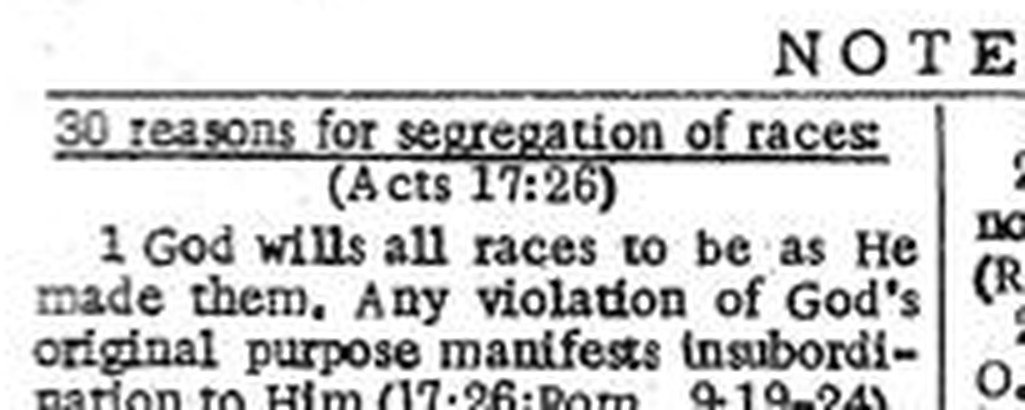
In the oldest copy, the top of New Testament page 159 carries a heading you cannot miss: thirty reasons for the segregation of the races. Chapter 20 walked you through that page. Appendix B prints every word of it.
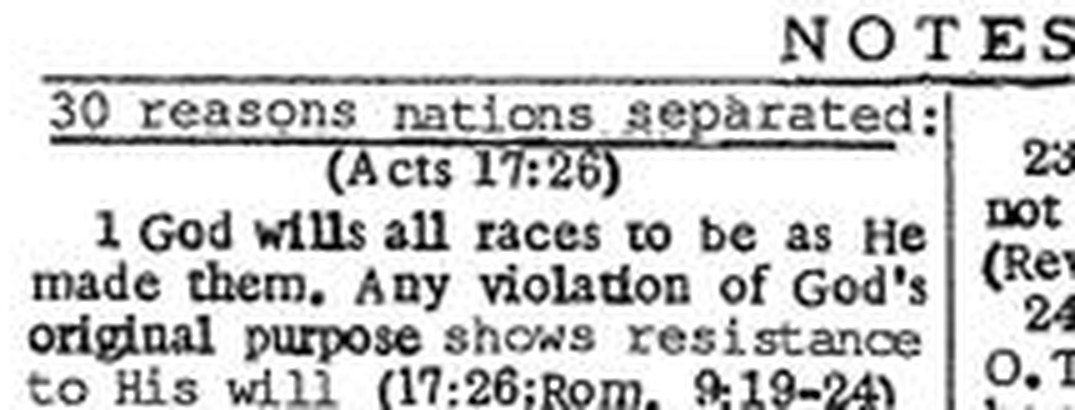
In the second copy, the heading is there and the thirty reasons are still there, but the language has been swapped. Segregation of races is now nations separated. Down the list, every instance of segregation has been pulled out and separation put in its place. One phrase naming two races by color is gone.1
In the third copy, the list is gone entirely. All that remains is a one-line pointer to somewhere else in the book.
Here is what I had to sit with. Nothing in either of the newer copies tells the reader what the older one said. There is no preface. No publisher’s note. No sentence on any page explaining that the notes were ever different. A person who buys a fresh copy and a person who inherited an old one are holding different books. Only one of them knows it.2
Finis Dake died in 1987. The changes came after.3 So this chapter is not about Dake. Every other chapter in this book looks at what he taught. This one looks at what other people did to his work after he was gone. That is a different question, and it needs different rules.
Let me tell you where I come down before I lay out the evidence, because a chapter like this can go wrong two ways. It can turn into a manhunt. Or it can turn into a shrug. I do not want either.
The change was right. A study Bible should not print thirty reasons for racial segregation under a verse about one blood. I am glad it was taken out. I will say so again before we are done.
The silence was wrong. And the silence is what this chapter is about.4
Key Point: The Two Verdicts of This Chapter
Both come from the same pages. First, the removal was good. That teaching should not have been there, and taking it out made the Bible better. Second, the method was not good. A study Bible that quietly corrects its founder keeps the halo while losing the history. Readers of later printings have no way to know what was there before, and no way to test what else may have changed.
This is a history chapter, not a doctrine chapter. It lives under a tighter rule. I will say only what the documents in my hands actually show. When the record runs out, I will tell you the record runs out.
What I have are scans and photographs from four volumes of this Bible, covering both of its typesettings.5 That is not a shelf of dated printings. The difference matters. I can show you the text changed. I can show you what it changed from and what it changed to. I can even show you the order in several places. But I cannot date every stage. I cannot count the printings between them.
One source has improved since I started this chapter. I now have a copyright page.6 It comes from the volume that supplies most of the cross-reference evidence below, and it carries a statement: Large Note Edition, First Printing, August 1979. That page does not date my copies of page 159 directly. But it pins one press run of the unaltered book to a month and a year, from the book’s own front matter.
For the rest, I tell old from new by two kinds of evidence.
The older setting is identified by what it says. It carries the thirty-reasons note on New Testament page 159. Printings from 1988 onward do not.7 The type is compact, three columns to a page, hard on the eyes.
The newer setting is identified by its running heads. When the book was reset, somebody made one genuinely helpful decision. On pages of continued notes, the running head now carries two page numbers: the new one and, in parentheses, the old. A head reading THE ACTS NOTES CONTINUED (158–159) 275 tells you that page 275 of this edition holds the notes that used to sit on pages 158 and 159 of the earlier one.8
That double numbering is a gift. It lets me place an old page beside a new one and know I am looking at the same material. Without it I would be guessing, and this chapter cannot afford guessing.
How I Label Editions in This Chapter
I never name a printing year the pages do not show. One volume carries a dated copyright page; I cite it by that date. The rest I label by what they contain. The two copies with the original wording I call pre-1988 printings, and I say why: they carry the note that later printings alter and then drop. The copy with the revised wording is labeled by the year its supplier gives it, with that limit noted. The largest resetting I call the newer typeset edition, and I cite both of its page numbers where the running head gives them.
One more limit, and it matters more than the others. My sources do not include a preface, an edition notice, or any publisher’s statement about the revision.9 That absence is itself evidence, and I will use it below. But I want to draw the line now. I can tell you no such statement appears in the pages I hold. I cannot tell you no such statement exists anywhere in print. Those are different claims. Only the first is mine.
Why be this careful about paperwork? Because the charge in this chapter is that somebody was careless with the truth. A chapter making that charge had better be meticulous with the truth itself. If I overstate by a single claim, every defender of this book gets to talk about my mistake instead of their thirty reasons. I would rather say less and hold all of it.10
Here is how I will work. Every claim about a change gets two witnesses: the same note in two states. Where I have both, I show both. Where I have only one side, I say so and stop.
I will not try to read anyone’s mind. Motive is not in my sources. Change is.
And I will keep this chapter where it belongs. The content of the segregation note is Chapter 20’s work. The Bible’s answer belongs to Chapter 21. The full edition table, cell by cell, lives in Appendix C. My only job here is to tell you what happened next.
One note on language. Where the old notes use racial terms, I quote them inside quotation marks and never use them in my own voice.11 That rule holds here the same as in Chapter 20.
You have already seen this page. In the pre-1988 printing, New Testament page 159 carries a running head reading NOTES ON ACTS OF THE APOSTLES CONTINUED. Below it is a heading that does not hedge: thirty reasons for the segregation of races, keyed to Acts 17:26.12 Then the thirty reasons, numbered, in small type.
Notice how they are printed. They appear in the same format the book uses for its lists of promises and lists of doctrines. This was not set apart as opinion. It was set as Bible teaching, in the format reserved for Bible teaching.
And it sat under this verse:
And He has made from one blood every nation of men to dwell on all the face of the earth, and has determined their preappointed times and the boundaries of their dwellings. (Acts 17:26, NKJV)13
That is all I will say about content here. Chapter 20 gave that page a full hearing, and Chapter 21 answered it from Scripture.
Now I want to show you something smaller than a vanished list. I think it tells us more.
The segregation teaching in the old Dake Bible was never just page 159. Notes across the canon pointed there. One of them sits in Exodus, at Exodus 33:16. That is the verse where Moses tells God that His presence is what separates Israel from every other nation on earth. In the pre-1988 printing, note k at that verse reads:
This is one of many scriptures proving the will of God in the complete segregation of Israel from all other nations (v 1; Num. 23:9). See 30 reasons for segregation of races, p. 159 of N.T. Dake Annotated Reference Bible, pre-1988 printing, note k at Exodus 33:16
Now the same note, same verse, in the newer typeset edition:
This is one of many scriptures proving the will of God in the complete separation of Israel from all other nations (v 1; Num. 23:9). See Separation in Scripture, p. 275 of N.T. Dake Annotated Reference Bible, newer typeset edition, O.T. p. 159, note k at Exodus 33:16
I checked these word by word under magnification, because I needed to be certain.14
The sentence is the same. The verse reference is the same. The parenthetical is the same, including the cross-reference to Numbers 23:9. Two things changed. Only two.
Segregation became separation. And the pointer that used to send you to thirty reasons on page 159 now sends you to a note called Separation in Scripture on page 275.
Same note. Same verse. Same parenthetical. One word swapped, one pointer moved, and nothing on the page saying either thing had happened.
I find this more revealing than the vanished list. A missing page could mean many things. Pages drop out in a reset. Lists get cut for space. But this is not a gap. This is someone reading a sentence and deciding one word had to go. Picking the replacement. Leaving the rest untouched. Then moving on to the next pointer. That is sentence-level editing. It is careful. It is knowing.
The new word does real work. Separation is a solid Bible word. It carries the sense of holiness and calling and being set apart for God. Segregation, in an American book printed in the middle of the twentieth century, carries something else. It carries law and custom and drinking fountains with signs over them.15
Look at what the swap does. It does not change the claim about Israel. The claim is word-for-word the same. What changes is how the note sounds to a reader in a later decade. The teaching stays. The connotation leaves.
And notice what was kept. The parenthesis still points to Numbers 23:9, the verse about a people dwelling alone. That is the covenant text, and an honest reader can do something with it. Keeping it was defensible. My point is not that every line of the revised note is wrong. My point is narrower than that. The same editor who kept the Numbers reference changed the word. Neither decision shows up anywhere in the book.16
Everything above compares two ends of a process. For a long time that was all I had. A before and an after. Then the middle turned up.
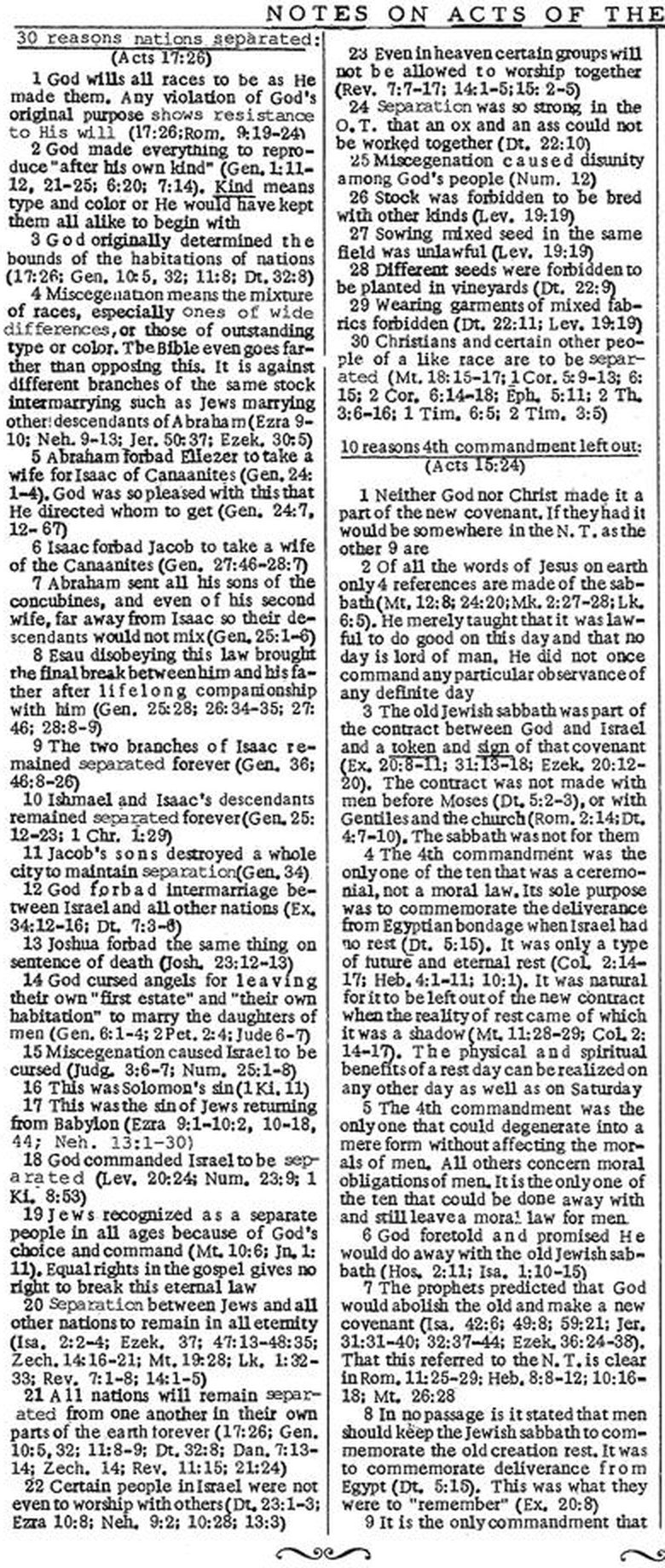
A third copy of page 159 reached me, from a printing its supplier identifies as 1990.17 I expected the page to be blank or given over to something new. It is not. The running head is the same. The page number is the same. The thirty reasons are still there, same order, under a heading one word different:
30 reasons nations separated:
(Acts 17:26) Heading, N.T. p. 159, 1990 printing18
The old heading said segregation of races. This one says nations separated. Both loaded words gone in a single stroke: the word that named the policy, and the word that named who it was about.
Go through the list. Read it slowly, because the pattern is precise.
The Same Thirty Reasons, Reworded
Reason 1. “manifests insubordination to Him” becomes “shows resistance to His will.”
Reason 4. “especially the black and white races, or those of outstanding type or color” becomes “especially ones of wide differences, or those of outstanding type or color.”
Reasons 9, 10, 18, 21 and 30. “segregated” becomes “separated,” every time.
Reason 11. “to maintain segregation” becomes “to maintain separation.”
Reasons 20 and 24. “Segregation” at the head of the sentence becomes “Separation.”
Reason 17. A missing book name is supplied. “44; 13:1-30” becomes “44; Neh. 13:1-30.”
Pre-1988 printings against the 1990 printing, N.T. p. 159, reasons as numbered.19
Now look at what was left alone.
Reason 2 still defines “kind” as meaning type and color. Reason 19 still says equal rights in the gospel give no right to break this eternal law. Reason 23 still says certain groups will not be allowed to worship together in heaven. The technical term for the mixing of races still stands in reasons 4, 15, and 25, untouched.20
Sit with that.
Somebody went through the note line by line. They caught every instance of one word and replaced it. They caught the clause naming two races by color and softened it. They even fixed a broken Scripture reference that had been wrong for decades. You do not fix a broken cross-reference unless you are reading closely.
And they left the doctrine standing.
Everything the note claimed, it still claimed in 1990. God wills the races as He made them. Colors are kinds. The gospel does not override the law of separation. Heaven itself will be divided. The only thing that changed was the vocabulary the claims wore.
Key Point: The Erasure Came in Stages
This was not a single event. It happened in at least two steps. First the words were changed, but the teaching stayed. Later the teaching itself was replaced. A reader who bought this Bible in the early 1990s owned a copy that still taught thirty reasons for keeping the nations apart, just in softer language. That reader was not told about the changes either.
Let me be careful about what this proves. It does not prove who made the decisions, or why. It does not tell me exactly when the first change was printed; 1990 is the supplier’s label, not a date I can read off the page.21 What it proves is sequence. There was a stage where somebody had decided the wording could not stay but had not yet decided that about the doctrine behind it.
And it proves one more thing, smaller but harder. A note that has been carefully reworded has been carefully read. Nobody can say afterward that they did not know what was in it.
How many notes actually needed changing? More than one. The old edition ran a web of cross-references, and page 159 sat at the center of it.
I can find pointers to that page in notes on Genesis, Exodus, Leviticus, Deuteronomy, Joshua, and Acts itself.22 Six books of the Bible, from the front of the Old Testament to the middle of the New. Each pointer, tucked into its own corner of the canon, told the reader where to find the full teaching. Pull out the page at the hub, and every one of those pointers becomes a dead link. They all had to be found and changed.
Then there is the index. And this is where the story gets hardest to look at.
The old Dake Bible carries a Concordance and Cyclopedic Index at the back. Under S, the pre-1988 printing has an entry for segregation. It is not a single line. In the volume I hold it runs sixteen printed lines, and it reads like a small syllabus.23 It points to segregation in Egypt. Twelve reasons God segregated Israel. Laws of segregation. Thirty-one facts on segregation in Moses’ writings. Segregation among the tribes. Four reasons for total segregation. God’s will in segregation. And at the bottom of the list, the thirty reasons on page 159. The entry directly above it, at the letter I, reads “Integration, a curse to Israel,” with a cross-reference back.24
Add up the destinations and you are looking at a dozen or more locations scattered through the book. This was not one stray note. It was a theme, indexed like a theme, cross-referenced the way the book cross-references the Trinity or the atonement.25
I want you to feel how large that is, because I do not think most people ever have. A reader could go to the back of this Bible, look up a single word, and find a reading plan. Fifteen stops. Genesis to Nehemiah and then across into Acts. Every stop annotated by the same hand, in the same voice, with the same authority the book brings to any other doctrine.
Now open the same index in the newer typeset edition. Same place in the alphabet. Segub is still there. Seir is still there. And where the sixteen-line syllabus used to be, four words:26
Segregation. See Separation Dake Annotated Reference Bible, newer typeset edition, Concordance and Cyclopedic Index, entry between “Seething” and “Segub”
The entries on either side are untouched. Same references, same order. In that whole stretch of the index, exactly one entry was emptied.
An index is the last place a careless revision reaches. Anybody can pull a page. Tracing every pointer into the back matter takes patience and a checklist. That emptied entry, sitting between two neighbors nobody touched, tells you this was thorough work by someone who knew what to look for. It also tells you how large the teaching was. You do not need sixteen lines to index one note.
Fairness requires one more thing here. The word segregated did not vanish from the newer edition entirely. It survives in at least one place where it has nothing to do with race, in a note about Christians living set apart from the world.27
That matters, and it cuts both ways. It rules out a simple find-and-replace. Whoever did this was reading for meaning. They changed only what needed changing. So the work was more careful than a word-scrub. It was also more deliberate. Every one of these decisions was made by someone who understood what the notes said and chose, note by note, what to do about it.
The old pointer sent readers to thirty reasons on page 159. The new pointer sends them to page 275, where a note is waiting. Its title is Separation in Scripture, keyed to the same verse, Acts 17:26.28
The space was not left empty. Something was written to fill it. What does it say?
It opens by quoting the verse it sits under, and it quotes it fairly:
This verse says God made “all nations of men” from “one blood”; it also speaks of “the bounds of their habitation.” In spite of a common ancestry, from Adam first and later Noah, it was God’s will for man to scatter over the earth, to “be fruitful, and multiply” (Gen. 1:28; 8:17; 9:1). Dake Annotated Reference Bible, newer typeset edition, N.T. p. 275, note “Separation in Scripture (17:26)”
Notice what that opening does. The one-blood clause is right there, quoted, in the first line. The old note built thirty reasons on the second half of the verse and never mentioned the first half. This note at least says it out loud. It grants a common ancestry.
From there the note grounds separation in two events rather than in race: Babel, where God confused human language, and the dividing of the earth in the days of Peleg.29 Then come numbered sections. The first covers separation for the line of the Messiah. The second covers separation within Israel: Abraham refusing a Canaanite wife for Isaac, Isaac doing the same for Jacob, the commands in Deuteronomy, Solomon’s marriages, the returning exiles.
I have to stop there, and I need to tell you why. My photograph of page 275 does not carry the end of the note. It breaks off partway through the second section, and the next page in my sources comes from a different part of Acts entirely.30 I do not know how the note finishes. I do not know whether a third section follows. I do not know where it lands.
I am printing that gap instead of guessing across it. Guessing is what got the old page written.
What I can say is limited but worth saying. The replacement keeps the frame of the old teaching: God separates peoples, and Scripture shows it. But it moves the ground from race to covenant and to the Messiah’s line. That is a real move, not just a cosmetic one. It puts “one blood” back on the page, which the old note never did.
Whether that amounts to a genuine change of mind or just a change of vocabulary, I cannot tell from a page and a half. I would rather say that honestly than pretend to know. When the rest of the note reaches me, it goes into Appendix C, and my reading can be tested against the whole thing.
Now the heart of this chapter. Everything above describes changes. This section describes what was not done alongside them.
In the pages I hold, there is no edition notice. No preface explaining the revision. No paragraph anywhere saying that earlier printings contained teaching the publisher no longer stands behind. The notes changed. The book never says so.31
Let me repeat the limit. I hold photographs, not a complete copy of either printing. It is possible that a statement exists on a page I do not have. If it does, I want to see it, and I will print it in Appendix C the day it reaches me.32
But this much the record carries. If a publisher wanted readers to know that this teaching had been removed, the obvious place to say so is the front matter. The obvious time is the printing where it went. A reader holding a newer Dake Bible today has no way to learn from the book itself what the book once said.
And there is a second silence, quieter than the first. The old edition told you where the teaching led. Six books of cross-references. Sixteen lines of index. That whole trail is gone, and its disappearance leaves no trace. A reader cannot follow a path that has been swept.
What makes this painful, and not just sloppy, is the kind of book we are talking about. This is a study Bible. Its whole promise is that it will show you the connections. Follow the letter, turn to the page, look up the word in the back. That reference machinery is the product. When that machinery is first used to lead readers toward a teaching, and then quietly re-aimed so nobody can find the teaching again, something deeper than a single page has changed. The instrument of study has been used to prevent study.33
Same Words, Different Meanings: “Revised” and “Updated”
How publishers use the words. On a title page, “revised and updated” normally means upkeep. New maps. Corrected typos. Fresh cross-references. Readers understand it as maintenance.
What the pages here show. A doctrine was removed. A word inside a sentence was swapped. Six books of pointers were redirected. An index entry was emptied. That is not maintenance. That is a publisher deciding its founder was wrong about something serious.
What honest correction sounds like. One sentence would have been enough: “Earlier printings of this Bible carried notes teaching the segregation of the races. We have removed them. We were wrong to print them.” Those words exist. They were available. They were not used.
Let me draw three lines around what I have shown, because a chapter like this can be over-read.
First, the removal was right. I will not hedge that or bury it. Someone at that publishing house looked at thirty reasons for segregation printed under Acts 17:26 and decided it could not stay. They were right. Taking it out made the book better. If you own a newer Dake Bible, you own a better book than the one your grandfather carried, at least on this page. I would rather live in a world where publishers take out material like this than one where they dig in and defend it. There have been publishers who dug in.
Second, I do not know why they did it. Maybe someone was ashamed. Maybe someone worried about sales. Maybe a family member picked up the old page with fresh eyes and could not stomach it. All of those are possible. None is in my documents. I have a set of changes and the absence of any statement about them. I will reason from those two things and nothing else.34
Third, the right lesson here is not that publishers are villains. It is something more useful and more uncomfortable. Unmarked revision is a method. It is a common way reference books get quietly updated, and it happens far beyond this one Bible. The question it should raise is not really about the Dake family. It is about your own shelf. Do you know whether the notes in your study Bible have a history? Would the book tell you if they did?
Because that is the real cost. Not embarrassment. Trust.
A reader who discovers on her own that her Bible’s notes once taught segregation, and that nobody told her, learns two things at once. She learns what the notes said. And she learns the book does not tell her things. The second lesson is the expensive one, and it is the one the silence bought. It is expensive because it does not stay in one place. Once you know that one teaching was removed without a word, you have no way to know what else may have moved.35
Let me make that practical. If you own a study Bible of any kind, go look at the front of it tonight. Find the copyright page. See whether it names a printing and whether it says anything about revisions. Then ask one question: if the notes in this book had once said something the publisher now regrets, would this page tell me?36
For most study Bibles the honest answer is no. That is not a scandal by itself. It is how the business works. I am not asking anyone to burn a book over it. I am asking you to hold the notes a little more loosely than you hold the text, and to know the difference between the two.
There is a cost to the publisher too. A house that had said we were wrong would today be one of the very few in American religious publishing that had ever said so out loud. That is a real thing. It was there for the taking. It was traded for continuity, and continuity is worth less.
If you are holding a newer copy right now, let me say the thing you most need to hear. The text of Scripture in your Bible did not change. Not a word of Acts 17 moved. What changed were notes in the margins, written by a man, printed by a company, edited after he died. That distinction is everything. The Bible is not the notes. The notes are one man’s reading of the Bible. Readings can be wrong. This one was.
Now you know. That is not a small thing. Most readers of the newer printings still do not.
“They fixed it. Be grateful and move on.”
I am grateful, and I have said so twice. But a fix made in silence is half a fix. The teaching is out of the new printings. It is still in millions of old ones, on shelves and behind pulpits, and nothing has been published to answer it. A word from the publisher would have reached those copies. Removal alone cannot.
That first defense is the most common one, and it deserves more than a box. Suppose a man teaches something harmful for thirty years and then stops. Stopping is good. But if he never says why he stopped, the people he taught still carry the teaching. Their copy still says what it said. Silence does not travel. Only words travel.
And Scripture is not neutral about how teachers handle a text. Paul describes his own ministry this way:
But we have renounced the hidden things of shame, not walking in craftiness nor handling the word of God deceitfully, but by manifestation of the truth commending ourselves to every man’s conscience in the sight of God. (2 Corinthians 4:2, NKJV)
Paul’s boast is not that his record is clean. It is that his method is open. Nothing hidden. Nothing sly. Everything placed where a conscience can examine it. That is the standard a Bible publisher should want.
“Publishers revise reference works all the time without announcing it.”
True, and I grant it freely for the ordinary business of publishing. Maps get redrawn. Prices change. Typos die without obituaries. Nobody expects a press release. But a doctrine of God-ordained racial segregation, printed as Bible teaching in a Bible, is not a typo. Its removal is either a repentance, which speaks, or a rebranding, which hides. There is no third option.
I want to press that point, because there is a real observation buried in the defense. Publishers genuinely do not annotate every change, and it would be silly to demand it. So where is the line? I would put it here: when a change is routine maintenance, silence is fine. When a change is a reversal on a question of right and wrong, silence becomes a decision about what readers get to know. The size of the correction sets the duty of the disclosure. This correction was enormous.
A third defense comes from the most careful readers, and it is the one I respect most. It says: you cannot prove they intended to hide anything.
That is correct. And I have not tried to.37
I have proved two things, both from the pages. The changes happened. No statement about them appears in my sources. Everything I have said about cost and trust follows from those two facts, and neither fact requires me to know what anyone was thinking.
Consider how much work a motive would actually do here. Suppose I could prove an editor sat down meaning to bury the past. That would make the story uglier. It would not make a reader of the newer printing one bit better informed. Now suppose the opposite. Suppose it all happened from embarrassment, or grief, or a wish to protect a family name. That would make the story sadder and more human. The reader would still be uninformed. The problem I am describing does not run through anyone’s intentions. It runs through what is on the page and what is not.38
So I am content to leave motive where it belongs. It is the one thing I have no evidence about, and the one thing my case does not need.
One more defense, less often spoken but often felt. Some readers will say that digging this up dishonors a man who cannot answer and hurts a family still publishing his work.
I understand that feeling, and I will not dismiss it. Grief for a father or grandfather is real and good. But think about who else is in the room. There are believers, many of them Black, who were handed this Bible as the meaning of Scripture and who read those thirty reasons as God’s will for their lives. Some of them are still in our churches. This record is not being turned over for sport. It is being told because it happened to people. Telling it plainly is the least the rest of us owe them.39
Paul told the church at Ephesus what to do with things that prefer the dark:
And have no fellowship with the unfruitful works of darkness, but rather expose them. For it is shameful even to speak of those things which are done by them in secret. But all things that are exposed are made manifest by the light, for whatever makes manifest is light. (Ephesians 5:11–13, NKJV)
Read the last clause. It is easy to miss. Whatever makes manifest is light. Bringing a hidden thing into the open is not hostility. It is the way anything gets healed. That is why this chapter exists.
I keep coming back to one proverb while I work on this chapter.
He who covers his sins will not prosper, but whoever confesses and forsakes them will have mercy. (Proverbs 28:13, NKJV)
Look at how that verse is built. Two actions. Both required. Confess and forsake. Say it, and stop doing it.
What I have shown you is a record of forsaking. The teaching was removed. The pointers were redirected. The index was cleared. Somebody did the second half of that verse, page after page. I am glad they did.
The first half never happened. Nothing was confessed. And the promise in the proverb does not attach to just half of it.
James says the same thing from the other direction, and he ties it to healing.
Confess your trespasses to one another, and pray for one another, that you may be healed. (James 5:16, NKJV)
Think about what one paragraph could have done. A publisher who wrote, we printed this, it was wrong, and we have taken it out, would have given the whole church something worth having. Every pastor with an old copy on his shelf would have known what to say. Every believer wounded by that page would have seen it named out loud. An erasure would have become a testimony. Testimonies heal. A hole in a book teaches nobody anything.
So here is what I would ask you to carry out of this chapter. Not suspicion. Attention.
Your Bible’s text is not the issue and never was. But the notes in the margin were written by a man, and men get things wrong, and the pages around a man’s words can be changed without telling you. Read the notes as notes. Test them the way the Bereans tested Paul: go to the Scriptures and see whether it is so.
There is something almost unbearable about where that command sits. The Bereans are in Acts 17. They are nine verses above the verse this whole chapter is about. Dake’s own notes list searching the Scriptures among the daily duties of a Christian, and in the newer edition that list is printed on page 275, the same page that now holds the replacement note.40 The remedy was always on the same page as the wound.
Chapter 23 follows the teaching outward, into the movements and the ministries where it traveled. Appendix C lays the editions out side by side, witness by witness, so you can check my work instead of taking it on trust.
And if you are holding the Bible your grandfather held, with his pencil marks still in the margins, I want to end where this book keeps ending. Keep it. Read it. Love the man who gave it to you. Then read the notes with your eyes open, carry them to the Scriptures, and let the God of one blood be larger than anything a footnote ever said about Him.
↑ 1. The middle witness is a copy of N.T. p. 159 from a printing identified by its supplier as 1990. Its running head reads “NOTES ON ACTS OF THE APOSTLES CONTINUED” with the page number 159, as the earlier printings do. The heading and reasons 1 to 5 and 14 to 22 were read by eye at six times magnification; the remainder rest on machine reading of the same image at word-level confidence, and eye confirmation of those lines is outstanding. See note 19.
↑ 2. The absence of any publisher statement is documented from the sources in hand at note 9 and in the seventh movement. The claim made here and throughout is precise: no edition notice, preface, or publisher statement regarding the revision appears in the pages resident in my sources. I do not assert that no such statement exists in any printing.
↑ 3. Dake’s dates (1902–1987) and the outline of his life are given in Chapter 2, which owns the biography. The 1988 date for the first altered printing follows the standing edition rule of this book, stated at note 4.
↑ 4. Both halves of that verdict are held throughout and neither is allowed to swallow the other. The improvement is credited without irony; the method is examined without pretending the improvement did not happen. A chapter that dropped either half would be easier to write and less honest.
↑ 5. The witnesses for this chapter are photographic and scanned pages of two settings of Finis Jennings Dake, Dake’s Annotated Reference Bible (Lawrenceville, GA: Dake Bible Sales), held in the project’s Study Bible library. Twelve archives of pre-1988 pages (60 photographed pages, Genesis through Revelation, plus Concordance and Cyclopedic Index pages) supply the older setting; eleven subject archives supply the newer typeset edition. Individual witnesses are cited by archive filename and internal page below.
↑ 6. Copyright page, Dake’s Annotated Reference Bible: copyright 1963 for the complete Bible, 1961 for the New Testament portion with Daniel, Psalms and Proverbs, and the printing statement “Large Note Edition, First Printing, August 1979.” Read by eye at four times magnification. Transcribed in full in Chapter 20, note 10, which also explains why this volume is treated as a separate witness from the copies of p. 159 rather than assumed to be one of them. That this volume carried the note is established from its own index and its own Acts 17 page, not from a photograph of its p. 159, which is not among my images.
↑ 7. Edition labeling per the standing rule of this book: pre-1988 printings are the baseline for what Dake taught; post-1987 printings are evidence of what his publishers changed. The older setting here is established as pre-1988 by content, namely the presence of the New Testament page 159 note. The one resident title-page scan (segregation archive 01, internal page 1) is the bare Old Testament title page and is undated.
↑ 8. The dual-pagination running head is the newer edition’s most useful feature for this kind of comparison. Notes-continued pages read [new page] ([classic page or pages]) [BOOK] NOTES CONTINUED. The instance quoted is from Dakes_Bible_PreAdamite.pdf, internal page 60, reading “THE ACTS NOTES CONTINUED (158–159) 275.” Read from the archive OCR layer; awaiting eye confirmation against the page image.
↑ 9. Confirmed by direct inspection of the resident library, July 2026: no dated title page, copyright page, preface, or edition notice of either setting is resident. This is a documented absence from the sources in hand, not a claim about the printed books as issued. Should any publisher statement, preface, or edition notice be obtained, it belongs in this chapter and in Appendix C, quoted exactly.
↑ 10. This is the standing discipline of the two history chapters in this book. Compare Chapter 3, where the same rule governs the newspaper record of the 1936 case: state what the documents show, with dates and sources, and nothing beyond.
↑ 11. Historical racial terminology appearing in the notes is reproduced as printed, inside quotation marks only, and is never adopted into this book’s own voice. The fuller treatment of the note’s own vocabulary belongs to Chapter 20 and Appendix B.
↑ 12. Pre-1988 printing, N.T. p. 159, running head “NOTES ON ACTS OF THE APOSTLES CONTINUED 159,” note heading keyed to Acts 17:26. Five copies (four distinct photographs) are resident: 09_Dake_Annotated_Study_Bible_Verses_on_Segregation_recognized.pdf internal pages 5, 6, and 7 (6 and 7 being the same shot), 10_...pdf internal page 1, and 12_...pdf internal page 3. Five further photographs of the same page are held in the project’s full library. The canonical verbatim transcription is Appendix B; Chapter 20 quotes it substantially. Heading and running head here read from the archive OCR layer; awaiting eye confirmation across the photographic witnesses.
↑ 13. Scripture in this book is quoted from the New King James Version unless otherwise noted. The exegesis of Acts 17:26, including the force of the boundaries clause, belongs to Chapter 21 and is not repeated here.
↑ 14. Both readings verified by eye against the page images at magnification, per the transcription protocol governing all image-derived quotations in this book. Before: 03_Dake_Annotated_Study_Bible_Verses_on_Segregation_recognized.pdf, internal page 4, note k, on the left page of a photographed spread whose running head reads “EXODUS 34 / The tables of the law renewed / Sundry things to be observed.” The pre-1988 printed page number was not firmly resolved and is therefore omitted rather than guessed; the note is cited by letter and verse anchor. After: Dake_Study_Bible_Invisible_New_Version.pdf, internal page 6, note k, right page of the spread, running head “God talks with Moses EXODUS 33 159,” giving newer-edition O.T. p. 159. In the newer setting the cross-reference title Separation in Scripture is set in bold italic, that edition’s house style for a named note.
↑ 15. The historical frame is kept short here and is sourced at the level of common historical fact; Chapter 20 carries what little more this book says about the era in which the note was printed and sold. The point in this chapter is about editorial method, not about mid-century American history.
↑ 16. Numbers 23:9, from Balaam’s first oracle, reads: “For from the top of the rocks I see him, and from the hills I behold him; there! A people dwelling alone, not reckoning itself among the nations” (NKJV). The verse describes Israel’s covenantal distinctness, and orthodox commentators have always read it that way. Its retention in the revised note is therefore not itself objectionable; the objection is to the undisclosed editing around it.
↑ 17. The year is the supplier’s label for the volume, not a date printed on the page, and I treat it as such throughout. What the page itself establishes is not a year but a stage: a printing in which the wording had been revised and the list had not yet been removed. Nothing in this chapter’s argument depends on the year being exactly right; it depends on this printing standing between the two I can characterize by content.
↑ 18. Heading, N.T. p. 159, revised printing. Read by eye at six times magnification before the display failure recorded in Chapter 20, note 11. The pre-1988 heading reads “30 reasons for segregation of races: (Acts 17:26)”; see Appendix B.
↑ 19. Collated line by line against the pre-1988 transcription in Appendix B. Reasons 1 to 5 and 14 to 22 of the revised printing were read by eye; reasons 6 to 13 and 23 to 30 rest on machine reading at word-level confidence, with eye confirmation outstanding. The full cell-by-cell comparison, with its witnesses, is in Appendix C. Reason 17’s missing book name is a real defect of the earlier printings, recorded in Appendix B; the reference could only ever have been to Nehemiah 13, and the revised printing supplies it.
↑ 20. Reasons 2, 19, and 23 stand in the revised printing in the same words as in the pre-1988 printings. The term used in reasons 4, 15, and 25 is likewise unchanged. This book reproduces such language only inside quotation marks and never in its own voice; the words themselves are quoted in Chapter 20 and Appendix B.
↑ 21. The point bears repeating because it is the kind of thing a careless reader will turn into a claim I did not make. I am not asserting that the first revision was printed in 1990, nor that it was the only intermediate stage. I am asserting that a printing exists in which the wording was changed and the list retained, and that it therefore stands between the two states this chapter began with.
↑ 22. Pointers to N.T. p. 159 located in the pre-1988 archives at: 02_...pdf internal page 2 (Genesis); 03_...pdf internal page 4 (Exodus 33:16, quoted above); 04_...pdf internal pages 2 and 8 (Leviticus, including a reference tied to Lev. 19:19); 07_...pdf internal page 4 (Joshua 23–24); 09_...pdf internal page 4 (Acts 17, classic N.T. p. 144, note c). Located via the archive OCR layer; all except the Exodus instance await eye confirmation. One reading is specifically unresolved: the Acts 17 note c pointer OCRs as “p. 155” where every other pointer in the library reads “p. 159.” This is very likely an OCR misreading of 9 as 5, but it is flagged here rather than silently corrected, and must be settled by eye and cross-read against the full library’s copies of the same page before this chapter is final.
↑ 23. Pre-1988 printing, Concordance and Cyclopedic Index, witness 11_Dake_Annotated_Study_Bible_Verses_on_Segregation_recognized.pdf, internal page 3. The entry’s sub-lines point to Old Testament pages 47, 60, 108, 114, 140, 148, 155, 183, 207, 221, 232, and 513, closing with “30 reasons for s., 159*.” Read from the archive OCR layer; awaiting eye confirmation. The count of destinations given in the body is drawn from these sub-entries and should be re-checked against the image.
↑ 24. Cyclopedic Index, p. 100, headword “Segregation,” in the volume dated August 1979; and p. 60, headword “Integration, a curse to Israel,” with its cross-reference. Both are printed and their confidences recorded in Chapter 20. The line count given here is of the entry as printed in that volume; a different printing could set the same entry in a different number of lines, and an earlier draft of this chapter counted eleven from a differently cropped witness.
↑ 25. The observation concerns format rather than content. Dake’s Study Bible presents its material in numbered lists under bold headings throughout, and applies that format uniformly to doctrines the church holds and to doctrines it does not. The uniformity is part of why untrained readers found the notes persuasive, a point developed in Chapter 1 and in Chapter 5.
↑ 26. Newer typeset edition, Concordance and Cyclopedic Index, witness Dake_Study_Bible_Invisible_New_Version.pdf, internal page 56. The entry stands between “Seething” and “Segub,” whose text and references are substantially identical to the pre-1988 setting at note 23. Read from the archive OCR layer; awaiting eye confirmation. The comparison of neighboring entries across editions is the control that distinguishes a targeted revision from a general reset, and should be verified with particular care.
↑ 27. Witness Dake_Annotated_Study_Bible___Trinity_New_Version.pdf, internal page 68, in a note listing marks of Christian conduct: “Christians live segregated from it,” keyed to James. Located via the archive OCR layer; awaiting eye confirmation. The survival of the word in a non-racial sense is included here because fairness demands it: it shows that the revision was discriminating rather than mechanical, which is evidence of both care and deliberation.
↑ 28. Newer typeset edition, N.T. p. 275, note headed “Separation in Scripture (17:26),” witness Dakes_Bible_PreAdamite.pdf, internal page 60, running head “THE ACTS NOTES CONTINUED (158–159) 275.” Read from the archive OCR layer; awaiting eye confirmation. Two further notes in the newer edition point readers to this page: the Acts 17 text page at newer p. 251 (Dakes_annotated_reference_Bible_Godhead_New_Version.pdf internal page 26, cross-filed at Dakes_annotated_reference_Bible__Omnis.pdf internal page 37), whose note c reads “See Separation in Scripture, p. 275”; and a Genesis note at Dakes_Bible_PreAdamite.pdf internal page 8, reading “Giants and Sons of God, p. 90; and Separation in Scripture, p. 275 N.T.”
↑ 29. The note cites Gen. 11:1–9 for the confusion of language and Gen. 10:25 for the dividing of the earth, the latter being the notice that in the days of Peleg “the earth was divided.” Dake’s reading of that clause as a physical splitting of continents is characteristic of his hyperliteral method, treated in Chapter 4, and is not evaluated here.
↑ 30. The photograph of newer-edition p. 275 breaks off within the second numbered section, at an item referring to the sin of Jews returning from Babylon. The following internal page in the same archive (61) is a different notes page entirely, and a search of all twenty-four resident archives returned no continuation. The remainder of the note is therefore not resident, and the note is not quoted here as complete. This gap is printed rather than bridged, and closing it requires either the continuation page or a copy of the newer printing.
↑ 31. See note 9. The distinction drawn in the body between what the sources show and what may exist in print is deliberate and is the standing discipline of this chapter.
↑ 32. Appendix C’s table is built on the same rule: no cell without a witness, and gaps shown as gaps. Any further later-printing witness extends the documented timeline by one step, and the timeline claims nothing beyond the printings actually in hand.
↑ 33. I state this as an observation about the apparatus, not as an allegation about anyone’s purpose. The cross-reference system and the index are what make a study Bible usable; when their entries are re-aimed and their trails removed, the effect on a reader is the same whatever the intention behind it.
↑ 34. This restraint is a rule of the book rather than a courtesy. Motives are attributed only where a publisher’s own statement exists in the sources; none does. What the record supports is stated in the body: that the removal implies the material was judged indefensible by those who removed it, and that the silence leaves readers of later printings uninformed.
↑ 35. That question is not idle in this book. The doctrinal notes examined in Chapters 6 through 19, on the Godhead and the divine attributes, appear so far to be unaltered across the editions in hand, and are quoted from either setting with the edition named. But the reader’s ability to know that rests on the same photographic comparison this chapter has had to perform, rather than on anything the book itself discloses.
↑ 36. The test is offered as a habit rather than as an accusation against any particular publisher. Its value is that it moves the reader from trusting a book’s apparatus to inspecting it, which is the same movement Chapter 25 asks for on every other question in this book.
↑ 37. See note 22. The refusal to assign motive is not a rhetorical concession offered for effect; it is the rule under which the chapter was written, applied from the first movement onward.
↑ 38. What the record does license, and what the body states, is narrower than a motive and harder to dispute: a publisher that removes material has judged that material indefensible. That inference runs from the act, not from anyone’s stated reasons, and it is the only inference of its kind this chapter draws.
↑ 39. The pastoral word owed to readers wounded by this teaching belongs to Chapter 21, which answers the note from Scripture, and to Chapter 25, which closes the book. This chapter’s obligation is the narrower one of telling the history accurately.
↑ 40. Newer typeset edition, N.T. p. 275, in the note headed “10 Daily Duties of Christians,” item 7: “Search the Scriptures (Acts 17:11).” Same witness as note 28, Dakes_Bible_PreAdamite.pdf internal page 60. Located via the archive OCR layer; awaiting eye confirmation. The Berean commendation reads: “These were more fair-minded than those in Thessalonica, in that they received the word with all readiness, and searched the Scriptures daily to find out whether these things were so” (Acts 17:11, NKJV).