Appendix B
The Complete Transcription of the Segregation Note, with the Photographs That Establish It
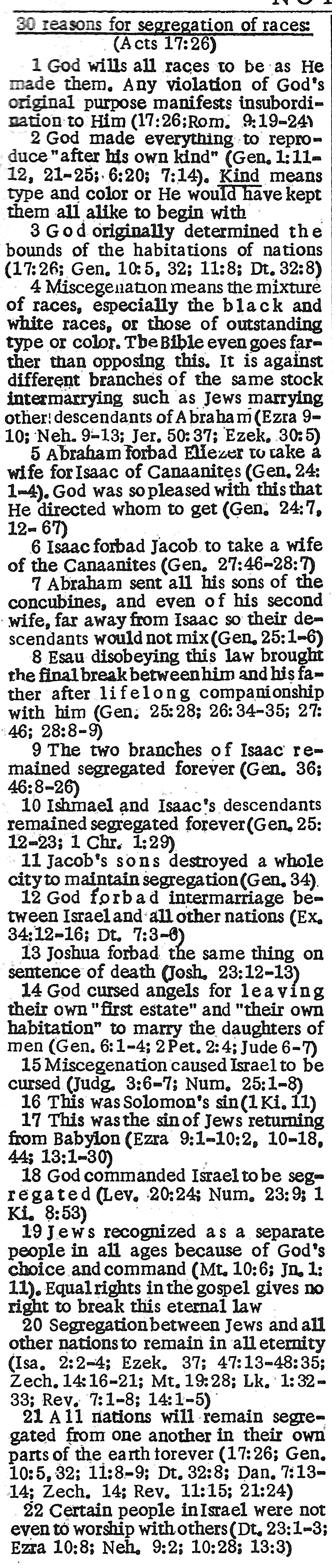
Open a pre-1988 printing of the Dake Annotated Reference Bible to page 159 of the New Testament. Find Acts 17:26. Look at the notes below the verse. There, in the same small type as the notes on faith and prayer a few pages over, you will find a heading: "30 reasons for segregation of races." Below it, thirty numbered arguments, each carrying Scripture references. No warning. No label. Just Bible annotation, printed like everything else on the page.1
This appendix does one thing. It puts that note on the record, complete and exact.
I have not summarized it. I have not softened it or sharpened it. Every word below was read from photographs of the printed page, and those photographs are shown here so you can check my work. That is the whole point of this appendix. Chapter 20 walks through the note and shows what it teaches. Chapter 21 answers it from Scripture. Chapter 22 tells what happened to it after Dake died. All three lean on this page, and this page holds no argument at all. It holds the text.
Why does a book written in love for Pentecostal believers print a page like this? Because the note is real, and people who carry this Bible deserve to see what it says. Because vague language has protected it for years. Calling it "controversial views on race" is not honest. The note says what it says, and the only fair way to weigh it is to read it, word by word, and then hold it up against the Bible it claims to be teaching.
So read it slowly. Then turn to Chapter 21 and read the verse it sits under.
The Rules This Page Follows
Nothing here is corrected. Nothing is modernized. Dake's spelling, his abbreviations, his punctuation, and his Scripture references appear exactly as the page prints them, including forms like "forbad" and shortened book names. Racial language inside the note is reproduced exactly and only inside the quotation. It is never adopted into the voice of this book. Where a word could not be read with confidence from the photographs, I say so rather than guess.
A photograph has to be read. It cannot be searched. So this transcription began the hard way: sitting with five photographs of this page from the project library, reading them by eye at four to eight times magnification, and writing down what I saw.2
After that first pass, two much better images arrived. They are 600 dpi scans of the whole page, one from a printing the author identifies as 1965 and the other from a printing he identifies as 1976.3 That gave this appendix seven witnesses in all, from at least two separate press runs. Every reading below was checked across these witnesses, and where a word needed comparison at magnification, the footnotes say so.4
The rougher machine text bundled with the library photographs is a different matter. It is badly garbled. I used it only to locate pages, never to take wording from it.5
Why the Method Matters
My first quick reading put the thirty reasons in the wrong order. At low magnification, I had reason two and reason three reversed. Enlarging the same lines corrected it, and both 600 dpi scans confirmed the fix.6 This note is quoted wrongly all over the internet. The way to avoid joining that crowd is to enlarge the page and look again.
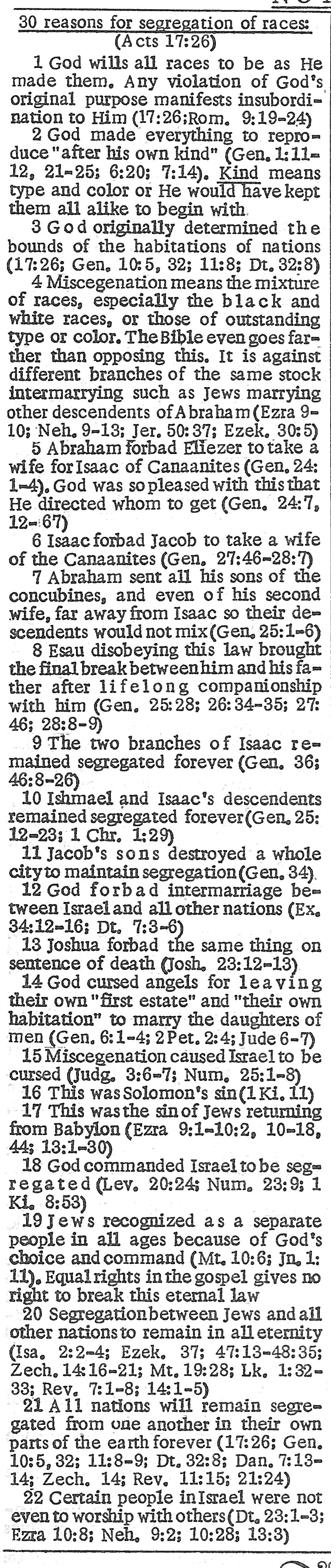
Four plates follow. The first three are cropped from the scan of the later printing. The fourth shows the same note in the earlier printing, so the two can be compared.
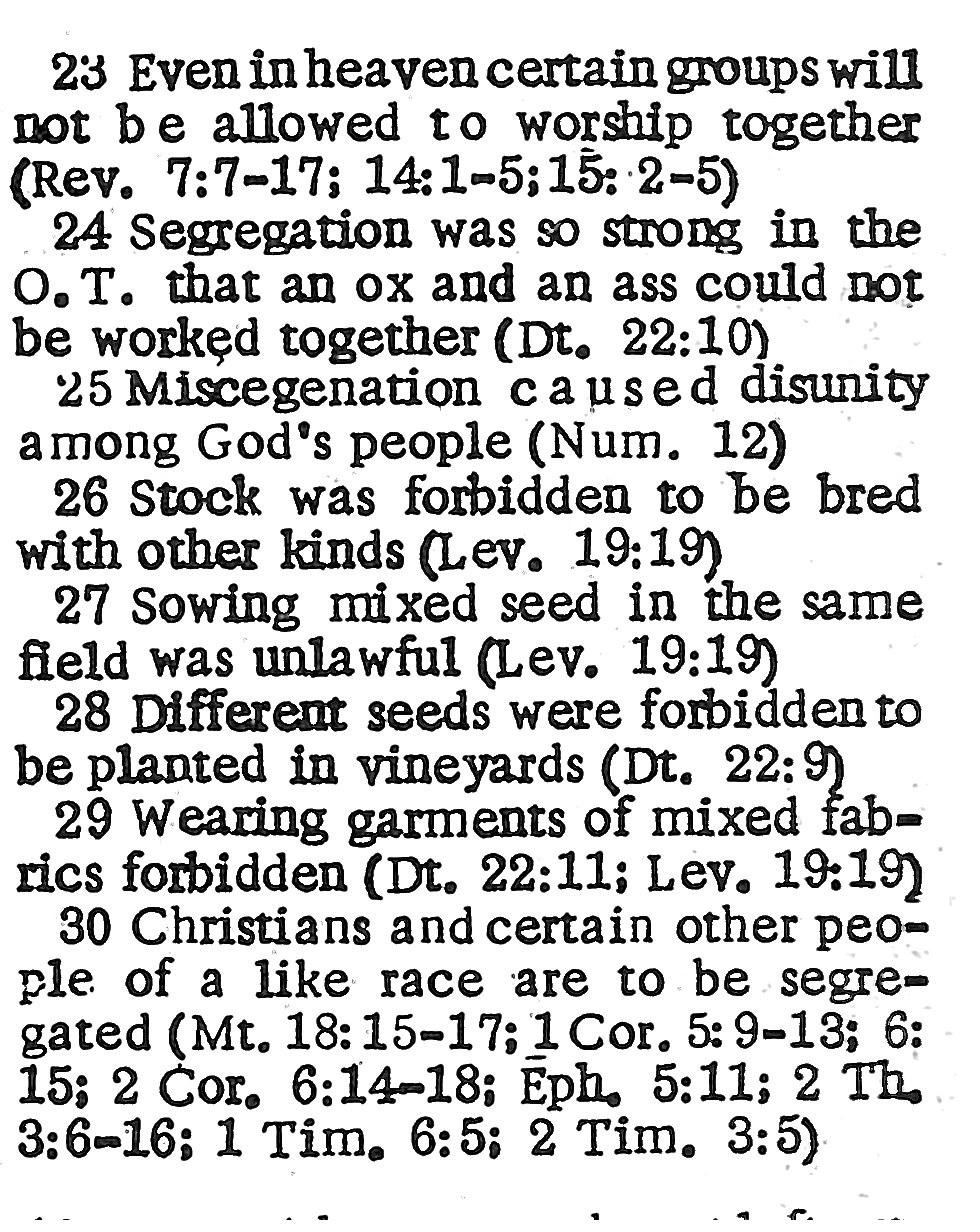
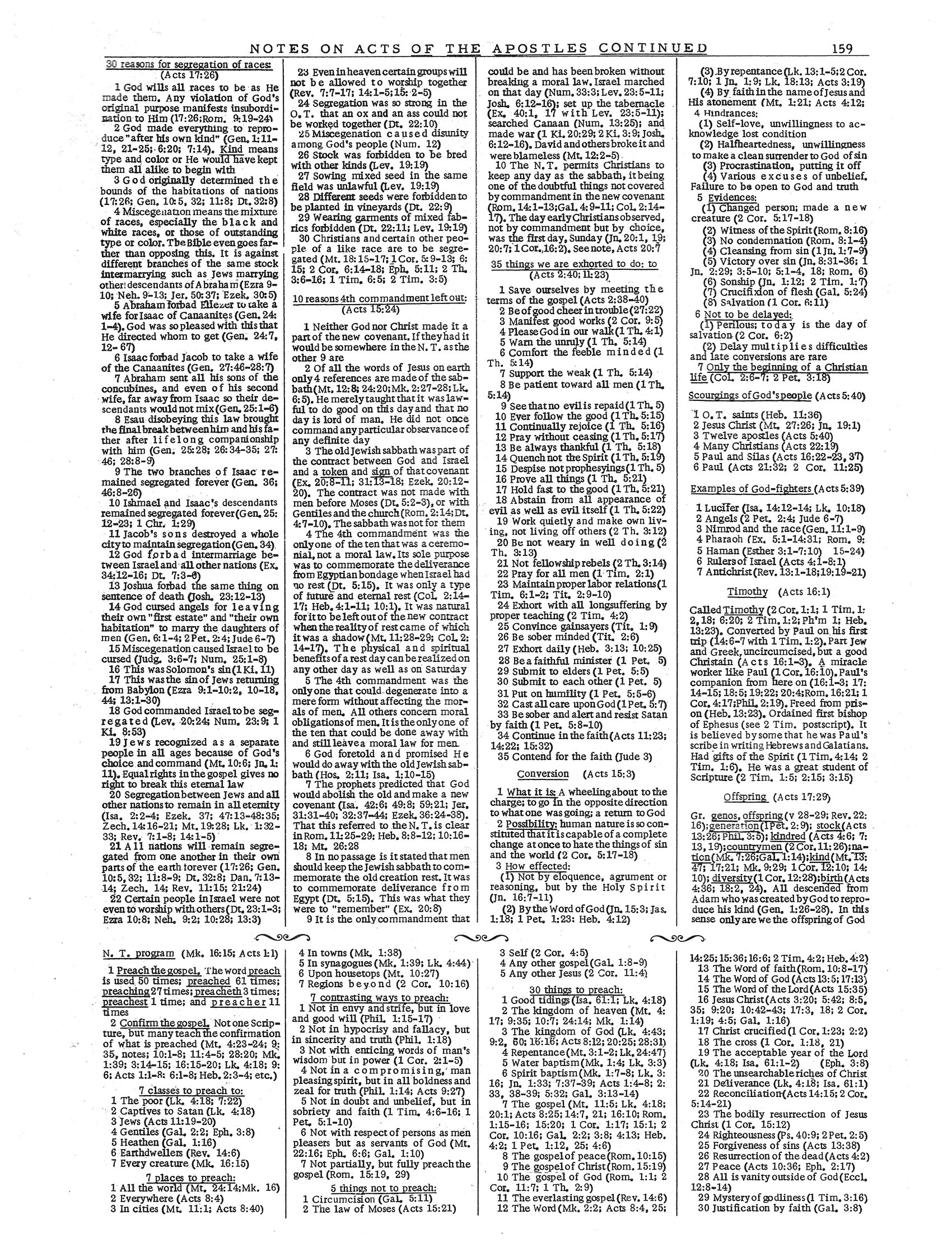
What follows is the note as it appears on the printed page. The heading and verse reference come first, exactly as printed. Then the thirty reasons, in their printed order.10 No footnote markers appear inside the transcription. Everything I have to say about particular readings comes afterward.
30 reasons for segregation of races:
(Acts 17:26)1 God wills all races to be as He made them. Any violation of God's original purpose manifests insubordination to Him (17:26; Rom. 9:19-24)
2 God made everything to reproduce "after his own kind" (Gen. 1:11-12, 21-25; 6:20; 7:14). Kind means type and color or He would have kept them all alike to begin with
3 God originally determined the bounds of the habitations of nations (17:26; Gen. 10:5, 32; 11:8; Dt. 32:8)
4 Miscegenation means the mixture of races, especially the black and white races, or those of outstanding type or color. The Bible even goes farther than opposing this. It is against different branches of the same stock intermarrying, such as Jews marrying other descendants of Abraham (Ezra 9-10; Neh. 9-13; Jer. 50:37; Ezek. 30:5)
5 Abraham forbad Eliezer to take a wife for Isaac of Canaanites (Gen. 24:1-4). God was so pleased with this that He directed whom to get (Gen. 24:7, 12-67)
6 Isaac forbad Jacob to take a wife of the Canaanites (Gen. 27:46-28:7)
7 Abraham sent all his sons of the concubines, and even of his second wife, far away from Isaac so their descendants would not mix (Gen. 25:1-6)
8 Esau disobeying this law brought the final break between him and his father after lifelong companionship with him (Gen. 25:28; 26:34-35; 27:46; 28:8-9)
9 The two branches of Isaac remained segregated forever (Gen. 36; 46:8-26)
10 Ishmael and Isaac's descendants remained segregated forever (Gen. 25:12-23; 1 Chr. 1:29)
11 Jacob's sons destroyed a whole city to maintain segregation (Gen. 34)
12 God forbad intermarriage between Israel and all other nations (Ex. 34:12-16; Dt. 7:3-6)
13 Joshua forbad the same thing on sentence of death (Josh. 23:12-13)
14 God cursed angels for leaving their own "first estate" and "their own habitation" to marry the daughters of men (Gen. 6:1-4; 2 Pet. 2:4; Jude 6-7)
15 Miscegenation caused Israel to be cursed (Judg. 3:6-7; Num. 25:1-8)
16 This was Solomon's sin (1 Ki. 11)
17 This was the sin of Jews returning from Babylon (Ezra 9:1-10:2, 10-18, 44; 13:1-30)
18 God commanded Israel to be segregated (Lev. 20:24; Num. 23:9; 1 Ki. 8:53)
19 Jews recognized as a separate people in all ages because of God's choice and command (Mt. 10:6; Jn. 1:11). Equal rights in the gospel gives no right to break this eternal law
20 Segregation between Jews and all other nations to remain in all eternity (Isa. 2:2-4; Ezek. 37; 47:13-48:35; Zech. 14:16-21; Mt. 19:28; Lk. 1:32-33; Rev. 7:1-8; 14:1-5)
21 All nations will remain segregated from one another in their own parts of the earth forever (17:26; Gen. 10:5, 32; 11:8-9; Dt. 32:8; Dan. 7:13-14; Zech. 14; Rev. 11:15; 21:24)
22 Certain people in Israel were not even to worship with others (Dt. 23:1-3; Ezra 10:8; Neh. 9:2; 10:28; 13:3)
23 Even in heaven certain groups will not be allowed to worship together (Rev. 7:7-17; 14:1-5; 15:2-5)
24 Segregation was so strong in the O.T. that an ox and an ass could not be worked together (Dt. 22:10)
25 Miscegenation caused leprosy among God's people (Num. 12)
26 Stock was forbidden to be bred with other kinds (Lev. 19:19)
27 Sowing mixed seed in the same field was unlawful (Lev. 19:19)
28 Different seeds were forbidden to be planted in vineyards (Dt. 22:9)
29 Wearing garments of mixed fabrics forbidden (Dt. 22:11; Lev. 19:19)
30 Christians and certain other people of a like race are to be segregated (Mt. 18:15-17; 1 Cor. 5:9-13; 6:15; 2 Cor. 6:14-18; Eph. 5:11; 2 Th. 3:6-16; 1 Tim. 6:5; 2 Tim. 3:5)
Finis Jennings Dake, Dake's Annotated Reference Bible, pre-1988 printing, New Testament p. 159, note on Acts 17:26. Transcribed from photographs.
That is the end of the note. The next heading in the same column reads "10 reasons 4th commandment left out: (Acts 15:24)," a sabbath note with no connection to this one.11 I print that heading here only so you can see where this note ends. No one can say something was left out.
This appendix now rests on scans from two different printings of the Dake Bible. That matters enough to say plainly.
The note reads the same in both. Same heading. Same thirty reasons. Same order. Same Scripture references. Nothing was added between the two printings. Nothing was dropped.
Two small differences did turn up, and they run the same direction. In reasons 4, 7, and 10, the earlier printing spells the word for offspring as "descendents." The later printing corrects it to "descendants."12 The earlier printing may also drop a letter from the long word at reason 25, printing "Miscegnation" where the later printing prints it correctly.13
If the spelling changes hold, they tell us something small but real. Somebody proofread this note between the two printings. A spelling error was caught and fixed. The note was not simply inherited and forgotten. It was read, corrected, and set in type again.
What that fact is worth, and how it sits beside what happened after 1987, belongs to Chapter 22 and the edition table in Appendix C. This page only records it.
Honest work on a transcription means telling the reader which parts were easy and which were not. Most of this note was easy. Five readings needed more care.
The order of the first three reasons. At low magnification I put them in the wrong sequence. Reason two is the "after his own kind" argument. Reason three is the "bounds of the habitations" argument. Enlarging the image corrected it, and seven witnesses agree, across two printings.14
Reason 20, "Zech. 14:16-21." On the closest photograph the colon nearly closes up, making the reference look like two separate entries. Both scans print it as a single reference.15
Reason 17, the closing "13:1-30." The references before it point to Ezra. But Ezra has only ten chapters, so a reference to chapter 13 cannot be Ezra. It is almost certainly Nehemiah 13, the chapter about separating the mixed multitude. I thought at first the book name had been lost in a bad photograph. It had not. Both printings print the reference this way, with no book name.16 The gap is Dake's, not the camera's. I have left it standing.
Reason 25, "leprosy." The library's machine text renders this word as "disunity," which makes some sense alongside Numbers 12. But machine text is not the page. Five photographs in the project library were cross-read at magnification, and the eye reading of multiple witnesses gives "leprosy," not "disunity."17 Numbers 12 is the chapter where Miriam is struck with leprosy after speaking against Moses for marrying a Cushite woman. Dake's point is the punishment: God sent leprosy. The word on the page is "leprosy."
Reason 30, "of a like race." This was the reading I trusted least. The verses cited there are all about church discipline, not ancestry, so the phrase sits oddly with its own references. But both printings read "of a like race," and that matches the reading taken by eye from the photographs.18 The phrase is his.
Two things are missing from this appendix, and I would rather name them than let anyone think the record is fuller than it is.
First, no printing year is established by the pages themselves. The two scans show single pages with no copyright information and no date in the margins. The years "1965" and "1976" are the ones the author assigns to the volumes they came from.19 What the pages prove on their own is narrower but still worth a great deal: two separate press runs, both carrying this note, both therefore printed before 1988, when the note disappears from the text.
Second, the later editions are not transcribed here. In the newer typeset edition the thirty reasons are gone from the Acts 17 page entirely. A short pointer sends the reader to a different note elsewhere in the book.20 That story belongs to Chapter 22 and Appendix C.
What This Appendix Proves
Two separate press runs of the Dake Annotated Reference Bible, both pre-1988, carry the same note, word for word, on page 159 of the New Testament. The note lists thirty reasons for the segregation of the races, printed beneath the verse that says God "made from one blood every nation of men." This is not rumor. It is not hearsay. It is on the page, in the photographs, and in the transcription above.
This appendix argues nothing. I built it that way on purpose. But I will not let a page like this end without pointing to the one that answers it.
The note sits under Acts 17:26. So read the verse above it.
"And He has made from one blood every nation of men to dwell on all the face of the earth, and has determined their preappointed times and the boundaries of their dwellings." (Acts 17:26, NKJV)21
Thirty reasons for separating the races, printed underneath a sentence about one blood. In two different printings, across at least two press runs. That is the shape of the whole problem, and I will leave it there.
For what this note is and where it sits in Dake's system, see Chapter 20. For the Bible's answer, worked through the note's own arguments one by one, see Chapter 21. For what Dake's publishers did with this page after his death, see Chapter 22 and Appendix C.
If you own a Dake Bible, you can settle the main question yourself in about a minute. Turn to Acts 17:26 in the New Testament section and look at the notes. What you find there, or do not find, will tell you which printing is in your hands.
↑ 1. Finis Jennings Dake, Dake's Annotated Reference Bible (Lawrenceville, GA: Dake Bible Sales, pre-1988 printing), New Testament, p. 159, note on Acts 17:26. The edition is established by the presence of the note itself; post-1988 printings removed it. See note 19 below.
↑ 2. The five library witnesses: Dake_Bible_NT_159.png (700 × 1568), Dake_Bible_NT_159_Racism.png (560 × 1316), the JPEG inside Dake_Bible_NT_159_Racism.pdf (952 × 1260), and pages 20 and 21 of 01_Dake_images.pdf (952 × 1260 and 672 × 1568). Despite file extensions, the ".png" files hold JPEG data and the "Dake_images" files are zip archives, not true PDFs. Transcription protocol: read the image directly, transcribe by eye, cross-read every disputed word against all available photographs, and mark any genuinely unreadable word as illegible rather than guessing.
↑ 3. Dake_Bible_1965_Page_NT__0159.tif (4580 × 5972, 600 dpi) and Dake_Bible_1976_Page_NT_0159.tif (4896 × 6440, 600 dpi), supplied by the author. Roughly eight times the resolution of the library photographs.
↑ 4. All readings in this transcription have been checked against both 600 dpi scans and the five library photographs. Where a reading needed resolution by comparison at magnification, the relevant footnote records it. Machine-generated confidence scores were used as a finding aid for locating words to check, but no reading in this transcription rests on machine text alone.
↑ 5. The machine text bundled with each archived page is heavily corrupted, rendering "segregation" as "se(!egation" and "Abraham" as "Abratem," among many other errors. It is treated throughout this project as a finding aid only. The author's own typed version of this note, published separately, is likewise treated as a finding aid and not as an authority; every reading here was taken from the page itself.
↑ 6. The error came from reading at roughly one and a half times magnification. It disappeared at five times and above, and both 600 dpi scans place the "after his own kind" argument at number two.
↑ 7. Cropped from Dake_Bible_1976_Page_NT_0159.tif. Site image folder path to be confirmed with the author before publication; the filenames shown are the delivered plate filenames.
↑ 8. Running head read from the same scan: "NOTES ON ACTS OF THE APOSTLES CONTINUED 159." Filenames in these libraries are the author's own labels and are never treated as citations; the page number is taken from the printed head.
↑ 9. Cropped from Dake_Bible_1965_Page_NT__0159.tif, first column, from the note heading down to the beginning of the next note.
↑ 10. Base text is the later of the two printings in hand. On the printed page the note runs in two narrow sub-columns: reasons 1 through 22 in the first, reasons 23 through 30 in the second. Printing them here in a single sequence is the only formatting change made.
↑ 11. Heading transcribed from the second sub-column, immediately below reason 30, and confirmed on the earlier printing's scan. Its content has no bearing on this appendix and is not reproduced here.
↑ 12. Confirmed by eye from the cropped plates: the 1965 crop clearly reads "descendents" at reasons 4, 7, and 10; the 1976 crop reads "descendants" at the same three places. Both spellings have been used in English; the earlier form is now rare.
↑ 13. At the resolution of the crops, the single missing letter in "Miscegnation" sits at the edge of what can be confirmed by eye from these plates. Machine reading suggests the earlier printing drops the second 'e'; the later printing prints it correctly. The word appears three times in the note, at reasons 4, 15, and 25. Final visual confirmation of the spelling difference is outstanding.
↑ 14. Five library photographs plus both 600 dpi scans.
↑ 15. Both scans print "Zech. 14:16-21" with the colon clear and legible.
↑ 16. Both printings read "(Ezra 9:1-10:2, 10-18, 44; 13:1-30)." Nehemiah 13 records Israel separating from the mixed multitude on the reading of the law, which fits the argument Dake is making. The book name is simply absent from the page.
↑ 17. The library's OCR renders this word as "disunity," but OCR is treated throughout this project as a finding aid, never as a quotation source. Eye reading of multiple photographs at magnification gives "leprosy," and the biblical context confirms it: Numbers 12 records Miriam being struck with leprosy after opposing Moses' Cushite wife. This is precisely the kind of reading that cross-photograph comparison is designed to settle. An earlier draft of this appendix carried the OCR reading in error; it is corrected here.
↑ 18. Machine reading confidence for the word "race": 96.3 on the earlier printing and 96.9 on the later. For "like": 96.3 and 96.0. These figures agree with the reading taken by eye at five and a half times magnification from Dake_Bible_NT_159_Racism.png.
↑ 19. The project's standing rule is to label such material "pre-1988 printing (edition established by the presence of the New Testament p. 159 note)" and never to assert a printing year the pages do not show. The bottom margins of both scans were checked and carry no date or printing code. A copyright page photograph is now held in the project (Dake_Bible_Segregation_Copyright_Page.png), but a copyright date establishes when the work was first registered, not when a particular copy was printed.
↑ 20. In the newer typeset edition the note at Acts 17:26 reads only "c See Separation in Scripture, p. 275," and the replacement note "Separation in Scripture (17:26)" appears at newer-edition p. 275, whose running head reads "THE ACTS NOTES CONTINUED (158-159) 275." Photographs of both pages are resident in the Study Bible project library. The full comparison belongs to Appendix C.
↑ 21. Acts 17:26, New King James Version. The Dake Annotated Reference Bible is now published in both King James and New King James settings, so this rendering meets the book's readers in a text they use. The exegesis of this verse, including the textual question behind the words "one blood," belongs to Chapter 21.